
The latest directorial venture of acclaimed director Christopher Nolan – a biopic on J. Robert Oppenheimer renowned as the father of the atomic bomb highlighted the use of technology to gain a military edge. As we commemorate the memorial to the dastardly bombing of Nagasaki by America this week, a little thought should also be given to the role of science in war. And to the lives of those scientists. These periods of war and conflict devastated countries and destroyed families. But the period of strife saw advancements in science, technology, communication and social dynamics.

The focus here is on the people that aided in creating these developments in science and technology. The research and development done by these people have had or have the potential to change the outcomes of war. This phenomenon was visible during both world wars. Unveiling new war equipment and ammunition, new methods of encryption provided technical superiority. It determined the difference between victory and defeat.
Coveting Knowledge, Destroying Lives
As such, the people behind these inventions were highly coveted. Or they ended up dying of mysterious deaths. The vilification of Oppenheimer under the guise of McCarthyism or the recent instance of the sudden death of Ou Yang Li-Hsing, Taiwan’s deputy head of the research and development unit in the defence ministry, brought the issue into the spotlight. It is a practice that continued over years. It involved bringing agents, the security apparatus and governments into the mix to carry out these activities.
Operation Paperclip, conducted by American intelligence, is one of the earliest recorded instances in modern history. It aimed to preserve German-made weapons. They included biological and chemical weapons. Later, the operation was expanded to include recruiting German scientists that aided the Nazi regime. American intelligence whitewashed their identities and provided them employment in American institutions.
One such individual was Wernher von Braun. Wernher von Braun designed the technology for the world’s first ballistic missile. The V1 and V2 missiles used by the Wehrmacht are a result of it. Used extensively during the London Blitz, they fired V1 and V2 missiles at England. The information from the British National Archives suggests that of the 6725 V1 missiles fired, 2340 hit London. It resulted in 5745 deaths and left around 16,000 injured. The V2 missile entered the war in September 1944. It compensated in speed for lack of accuracy. The V2 missiles hit nearly 1400 targets in London.

Source: Smithsonian Magazine
The efficiency of the missiles used by the Wehrmacht prompted the USA to employ him. The V2 missile tests led by Wernher von Braun at White Sands in New Mexico became the foundation for the American space program and missile development. Later, he became Director of the Marshall Space Center and aided in the Apollo missions.
As the world entered the Cold War immediately after the second world war, scientists working in space and nuclear research became targets of intelligence agencies. Such claims are commonplace in conspiracy theories. But documents from the past emerge through literature, declassification and leaks and cast a shadow of a doubt. It pushes the conspiracies into the realms of possibility.
A few months ago, an excerpt from the book Conversations with the Crow went viral on Indian Twitter. The excerpt ‘Conversation No. 22’ held information on the untimely deaths of former PM Lal Bahadur Shastri and leading Indian nuclear scientist Dr Homi J Bhabha. It was among the many conversations the author Gregory Douglas had with ex-CIA sleuth Robert Crowley.
In this conversation, Crowley speaks about the problems the US had with India for harbouring the ambition to become a nuclear power. India needed a nuclear deterrent after the loss in the 1962 war and the nuclear test by China in 1964. Crowley called Dr Bhabha an arrogant prick for putting national interest above US concern. Further ahead in the conversation, he mentions the death of Dr Bhabha as an unfortunate accident.
Dr Homi Bhabha was travelling to Vienna when Air India 101 crashed in the French Alps. All 116 people on board died in the crash. Crowley claims a bomb went off in the cargo of the Boeing 707 en route to Vienna. He boasts they could have blown the plane over Vienna, but the CIA felt the high mountains were a better location for the bits and pieces to come down.

Source: The Print
It raised the demand for an investigation into the event once again. Similarly, the death of space scientist Dr Vikram Sarabhai raised questions. Like the former PM Lal Bahadur Shastri, no post-mortem was conducted after his death. His daughter Mallika speaking to the Times of India, said the family felt no need for a post-mortem. However, author Amrita Shah, in her book ‘Vikram Sarabhai: A Life’ points toward the possibility of international foul play.
Sabotage of Space & Nuclear Programs
As countries in the Global South tried to build nuclear and space capabilities for defence and civilian use, there were attempts to sabotage the process. India and Iran had to bear the consequences of these attempts.
Iran today is facing sanctions for pursuing its nuclear program. The nuclear deal secured in 2015 is in tatters. It is of note to know the Iranian nuclear program started in the 1950s with American support. The US provided support to Iran under the Atoms for Peace program. Later, Iran became a signatory to the Non-Proliferation Treaty in 1970. The regime change during the Iranian Revolution ended the cooperation.
The regime changed the approach of Iran’s foreign policy. Iran refused to recognise Israel and declared the country an enemy state. And their successful attempt at making a nuclear weapon makes it a security challenge for the neighbourhood. Though Iran maintains its nuclear program is peaceful. Among these counterclaims, nuclear scientists became the target of containing Iran.
To date, six Iranian nuclear scientists have succumbed to assassination attempts. The death of Ardeshir Hosseinpur in 2007 is the first such instance. He is said to have died of gas poisoning due to a faulty heater. A spate of attacks on Iranian nuclear scientists between 2010 and 2012 made it a prominent issue. The latest assassination happened in November 2020. Top atomic scientist Mohsin Fakhrizadeh was shot dead using a remote-controlled weapon. Rear Admiral Shamkani, head of the Supreme National Security Council, confirmed to BBC that it was a remote attack using ‘special methods’.
Like Iranian nuclear scientists paid with their lives for their nation’s security goals, Indian nuclear and space scientists paid with their lives for India’s energy and technological needs. The case of former ISRO scientist Nambi Narayanan is one of many instances of sabotage. It is tame compared to the fate of other scientists.
Between 2009 and 2013, ten Department of Atomic Energy employees died in mysterious circumstances. Speculation is rife that the scientist and engineers employed with DAE were working on the nuclear program to harness energy using thorium. India drew a blueprint to achieve energy independence in the 1950s. It would build fast breeder reactors to meet energy needs harnessed through enriched thorium.
But people involved with the Indian nuclear program end up dead in unexplained ways. A PIL (public interest litigation) filed by RTI activist Chetan Kothari sheds light on the issue. His plea filed before the Bombay High Court requests the court to pass an order asking the government to constitute a team to investigate their mysterious deaths.
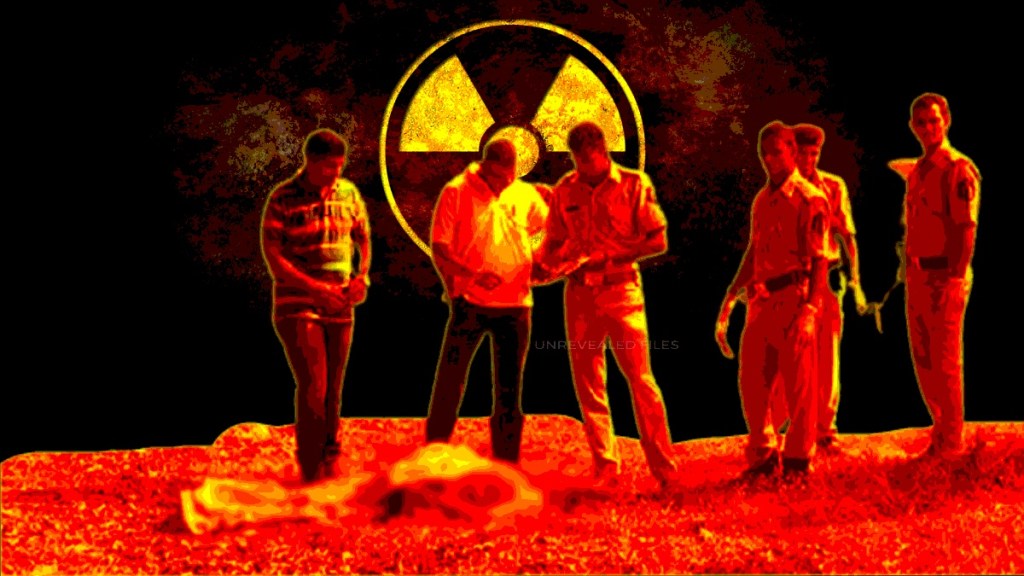
L Mahalingam, a senior scientific officer who worked at the Kaiga Atomic Power Station, went for a morning walk on 8 June 2009 and never returned. His decomposed body was found five days later in the River Kali. A few months later, in November 2009, drinking water at Kaiga was contaminated with tritium. Twenty employees fell ill, and 90 people received medical attention.
Source: Unrevealed Files
In 2013, two engineers assigned to the nuclear-powered submarine, INS Arihant, K K Joshi and Abhish Shivam, were found lying on railway trackers. Railway workers rescued them from being run over by a train but found no signs of life in them. The police and relatives claimed there were no injuries on their bodies. It is suspected they were poisoned, and their bodies were dumped on the tracks.
And five years ago, a top ISRO scientist claimed he was poisoned in an attempt to eliminate him. The 60-year-old scientist Tapan Mishra was the Senior Advisor to ISRO at the time of the assassination attempt. Speaking to ‘The Hindu’, he said, “This happened in 2017 in the Bengaluru campus of ISRO. It was an attempt to eliminate me.” He posted about the assassination attempt on his Facebook profile before it gained media attention.
These are not isolated cases. The PIL filed by Kothari shares information on the deaths of BARC and ISRO employees. BARC reported 680 deaths over 15 years across its installations. Over 90 employees of the Indira Gandhi Center for Atomic Research died during this period. Only 16 deaths were declared suicides. The cause of death of the other employees remains a mystery.
A similar story played out at ISRO as well. In the same period, ISRO lost 684 personnel. The theory behind the untimely deaths of these employees is the role of a foreign hand; to sabotage the space and nuclear programs of the country. The lack of proper investigation into these incidents by Indian authorities adds credence to the theory.
The work done by scientists, engineers and other employees in sensitive sectors upholds national interest. But as former Head of R&AW Vikram Sood describes in his book The Ultimate Goal – national interest was an ideal concept as long as it was American or British; otherwise, it was deemed ‘fascist’ or ‘anti-people’, a danger to the free world. It reflects the state of present-day geopolitics aptly. And have the employees working in sensitive installations, especially scientists become acceptable collateral in the game of geopolitics?
Discover more from The Critilizers
Subscribe to get the latest posts sent to your email.

 The Critilizers