
TikTok, the Chinese social media platform, owned by ByteDance has stopped its services in the United States of America. The app went offline before the enforced ban kicked in. Users in America could not access the services provided by TikTok.
The following message: “A law banning TikTok has been enacted in the U.S. Unfortunately, that means you can’t use TikTok for now.” The message was also optimistic about being reinstated after President Trump promised to reinstate the social media app. 18 hours later, TikTok US resumed services.
Despite resuming services temporarily, the future of TikTok in the U.S.A. is still uncertain. President Trump can provide relief to TikTok through an executive order. The executive order though only delays the ban by 75 days.
Why Is TikTok Banned In USA?
Chinese applications and its e-commerce platforms are under scrutiny in various countries. Data laws passed by the Chinese government give them the mandate to right to request data from China-based companies. These laws, extra territorial in nature, jeopardise the privacy of all consumers using any Chinese application.
There is no way for foreign governments to know how the data of their citizens will be utilized by the Chinese government. While data utilisation of private citizens by foreign entities is a concern, there are other issues. These issues could compromise natural security and sovereignty.
Former FBI director Robert Wray at a Congressional hearing raised the following concerns regarding TikTok. He raised concerns that TikTok could misuse its recommendation algorithm for influence operations. And the app could be used to control mobile devices and compromise personal data.
To safeguard against the potential threat posed by TikTok, the US government passed the Protecting Americans from Foreign Adversary Controlled Applications Act (PAFACA). It was signed into law by President Biden on April 14, 2024. It identifies China, North Korea, Russia, and Iran as adversaries.
The law prohibits distributing, maintaining, or providing internet hosting services for a foreign adversary controlled application. Though the law was framed to coerce TikTok and ByteDance, it can be utilized against any application that is deemed to be owned by a foreign adversary.
Under the aegis of the law, the US government forced TikTok to divest its business in the US. Or sell their business to an American company. If TikTok’s parent company ByteDance did not comply, it would have to suspend its services.
Possible Aftermath and the Legal View Point
The ban on TikTok would affect 170 million users in the US. The advent of this short-form video app and its counterparts on other platforms birthed the influencer phenomenon. Influencers became an advertising medium to dictate public opinion. They built their personal brands to earn their livelihood.
TikTok gained greater prominence after it launched its e-commerce service – TikTok Shop in September 2023. It increased the popularity of the application in America. Within a year of the launch of its e-commerce services, TikTok managed to capture 22% of the American e-commerce market.
Its success led many businesses to utilize its e-commerce services to sell their products to half the populace in the US. To date, almost 7 million businesses use TikTok to sell their products. The ban jeopardises the jobs of thousands of people dependent on these companies. Its impact is not just domestic. The TikTok ban can see layoffs across SEO and digital marketing agencies in other territories.
To keep their business afloat, both ByteDance and the businesses selling their products on TikTok appealed against PAFACA. They contested the law on the basis, it violated the 1st Amendment of the United States Constitution.
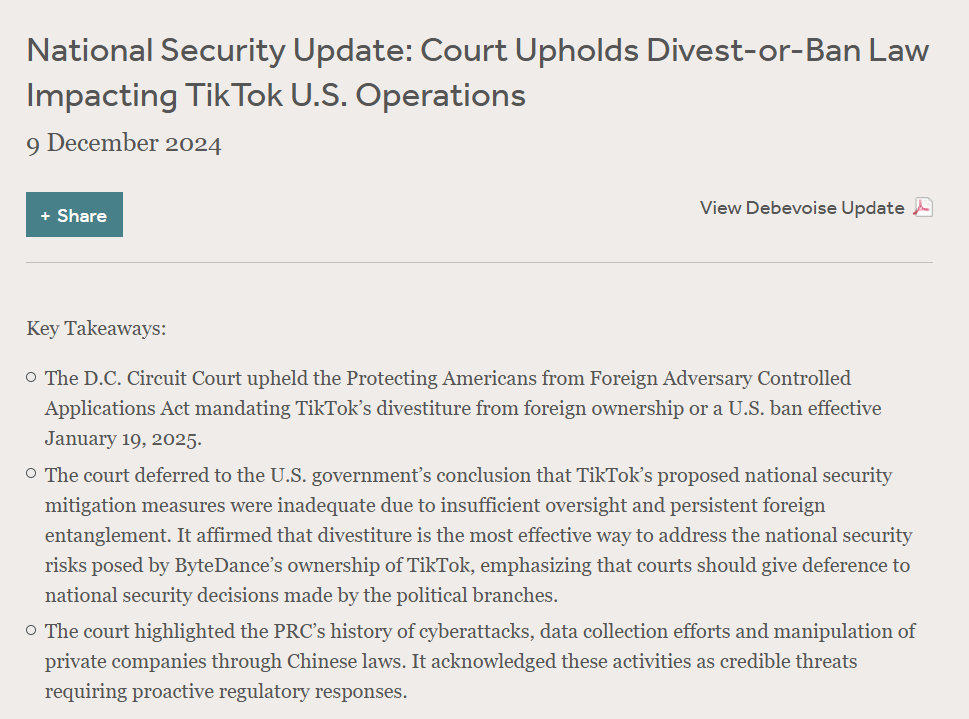
In the cases, the US Supreme Court ruled in favour of the government. The court in its judgment made the following observations. The US Supreme Court found the law does not violate the First Amendment for – it does not regulate protected expressive activity, or conduct with an expressive component. Nor did the petitioners identify any case in which the court has treated regulation of corporate control as a regulation of freedom of speech.
Upholding the stipulated rules of PAFACA, the court mandated the divestment of TikTok from foreign ownership. Or it would effectively face a ban from January 19, 2025. Agreeing with the stand of the US government, the court concluded TikTok’s safeguards against Chinese national security laws are inadequate. And upheld the government’s decision to force TikTok to divest its business in America.
Post the court order, TikTok was given 270 to 360 days to divest its operations in the US or face a legally enforced ban. It complied with the ruling and stopped its services ban came into effect. The app received a lifeline after President Trump had a change of heart after he experienced the role TikTok played in his successful presidential campaign.
The positive response from Trump saw TikTok resume its operations within a day. However, ByteDance, TikTok’s parent company stopped services of its other applications. They include Lemon8, CapCut, Gauth, Hypic, Lark, Tokopedia and more.
TikTok has 75 days, starting from 20 Jan 2025 to divest its operations in the US.
What Next for TikTok?
Anticipating the ban, American TikTok users shifted from Chinese-owned TikTok to another Chinese app – RedNote. Tech experts and government insiders in America are worried RedNote is more vulnerable to data and censorship requests.
The idea to wean the American public away from one Chinese app has resulted in people joining another Chinese app. It defeats the purpose of PAFACA. E-commerce businesses are moving from TikTok to Flip to safeguard their business interests and livelihoods. As TikTok is losing users to rivals, there are American entrepreneurs and businessmen looking to buy the American subsidiary of the app.
There is a lot of speculation on who would be buying the American subsidiary of TikTok. Elon Musk, former Treasury Secretary Steve Mnuchin, YouTube celebrity MrBeast, the owner of Perplexity AI, Aravind Srinivas, and others have expressed interest
While there is initiative from the entrepreneurs in America, the question to be asked is will China allow ByteDance to sell TikTok? China has over the years painstakingly developed indigenous alternatives and controls large chunks of data to compete with the MAANG companies.
Amidst the threat of tariffs and a trade war brewing, it is highly unlikely China would allow any divestment of its tech companies. Allowing the sale would set a precedent. It enables America to target other Chinese applications with a large number of American users. Neither China nor other countries want to find themselves in a position where a foreign government can arm-twist local businesses to sell or divest these American subsidiaries.
Though stranger things have happened, at present, the probability of a divestment seems highly unlikely. It is more probable that TikTok will go offline as the 75-day extension comes to an end.
Discover more from The Critilizers
Subscribe to get the latest posts sent to your email.

 The Critilizers