The 1990s are a pivotal decade in the story of India. Along with the liberalization of the economy, the Indian government passed the 73rd and 74th Constitutional Amendments in 1992. The enacted laws gave the existing local governments statutory authority.
Urban local governments – the municipalities and municipal councils responsible for urban governance failed to anticipate the mass migration of people to the cities. To create housing and other basic amenities, the local bodies created infrastructure without heed to urban planning and design. It led to encroachment of parks, urban forests, flood plains, and other sensitive ecological zones.
With discourse on climate change and global warming reaching into homes, people are realizing the existence of a local government and the damage caused by unplanned expansion of cities. This rise in awareness has sparked a demand for creating new, viable urban green spaces and preserving existing ones. However, creating these verdant urban spaces has become an avenue for vanity infrastructure projects. This reveals a peculiar anomaly. Instead of being the green lungs of cities, these newly built parks resulted in the loss of existing green cover.
Role of Parks In Urban Spaces
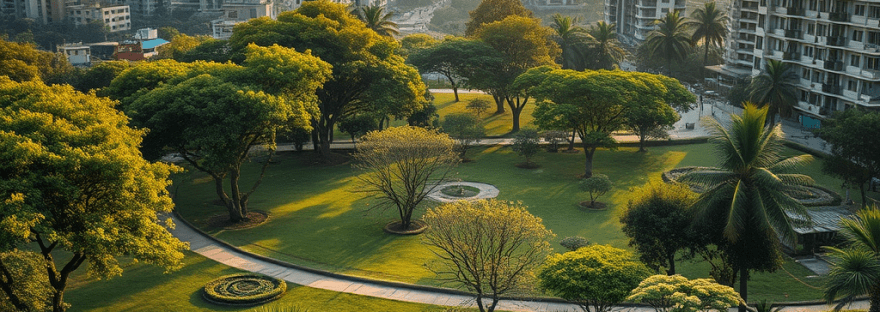
From a layman perspective or a policy viewpoint, the outcomes of these infrastructure projects do not meet the intended objectives. A common visualization for the word park is – a vibrant, green space with large shade giving trees, carpeted gardens with local flora dotting the landscape. It provides respite from the vagaries of climate and regulates climate in the vicinity.
A lack of such understanding invites policies and decisions that benefit neither the city nor the citizens. The Ambedkar Memorial Park built in Lucknow is one such decision. Constructed on a budget of ₹600 crore, this park spread over 108 acres does not house a single tree. Made using sandstone, this stone structure in the middle of the city resulted in the increase in microclimatic temperature inside and around the park.

Source: International Journal of Recent Advances in Multidisciplinary Research
This rise in average temperature is caused due to the stone used in building this park. The stone gets heated due to scorching sun. This creates a gradient, leading to hotter temperatures in the locality compared to other places in the city. Consequently, this public open space changed the local micro-climate. It caused a lot of discomfort for people visiting the park and local residents.
Unlike the Ambedkar Memorial Park, a public open space is a well designed and maintained. It can provide areas for appreciating nature, and for recreation and sport. With sustainability emerging as a lifestyle, there is an expectation among the people to reside in livable and sustainable cities that offer a great quality of life.
In modern urban policy, urban green spaces are considered to be the foundation for sustainable urban development. Properly planned and designed parks provide a lift to the adjacent neighbourhoods. They become a hub of community activity, encourage a healthy and active lifestyle, and have the potential to boost the local economy.
Such planned parks add social value. Built for a specific purpose, these public spaces provide significant social, ecological, and economic benefits. For these benefits to be visible, parks must feature as critical components in the local infrastructure plan. The famous Central Park in New York, the Amsterdamse Bos park in Amsterdam make the case for it.
The objectives of the early park design was to create sceneries depicting the rural and natural sceneries in their original form. Constructed in the 1850s, the Central Park is a testament to this naturalistic style of park design. Spread over an expanse of 341 hectares, the park is home to roughly 26,000 trees. The park is situated along 200 acres of lawns and meadows. It also encompasses 136 acres of forest. The park acts as a natural barrier and feels like a separate entity from the busy city. This separation creates a calm, healthy environment away from the fast-paced hustle of urban life.
As park design evolved, ecological functions became a part of the design. With changes in technology and improvement in design tools, including ecological function in design has become easier. The Amsterdamse Bos Park is one of the earliest to include ecological function in its design. A multidisciplinary team designed the park in 1900. This team consisted of teachers, botanists, biologists, engineers, sociologists, and town planners. The park still serves its stated objectives.
Keeping pace with changing lifestyles and technological advancements, urban local bodies and urban planners updated the ecological, social, and economic function of green spaces in urban design. These principles were codified at the European Landscape Convention held at Florence in October 2000.
It is quite unlike the approach in India. There are certain lacunae in our approach to policy making that need correction. A major impediment being documentation of successful policy intervention or policy decisions. It deprives local governments of necessary learning and data for better implementation of urban design and policy.
Unplanned Urban Planning Leads to Costly Mishaps
The lack of understanding about design and policy is quite evident. Operating in silos and personnel not equipped to meet the challenges of the 21st century, urban infrastructure development is operating on a narrow scope of housing. Urban public spaces and planning are an afterthought of housing.
Such ill-planned construction is prone to mishaps. Like construction of parks causing a loss of green cover. The Oxygen Bird Park is Nagpur is a prime example. Developed as a eco-tourist destination boasting a 3.1 hectare Miyawaki forest, it was inaugurated with much fanfare in 2024. The objective of building the park was to improve biodiversity and combat pollution.
Satellite images of the park tell a different tale. A concerned citizen posted a reel on Instagram highlighting the loss of green cover. The first image in the reel, taken on Oct 1, 2022, shows an area full of greenery. The second image, taken on Feb 1, 2025, a few months after the park’s inauguration, shows the drastic reduction of greenery.
It is not an outlier. There are several planned urban spaces that ended up achieving unintended outcomes or sometimes lacked vision and ambition. In the town of Vizag, city beautification projects to improve quality of life led to loss of trees in multiple parks. While the beautification efforts achieved unintended outcomes, the local government in Hyderabad paid lip service in an effort to build a park.
The commissioned park in Hyderabad was to commemorate the decennial of Telangana’s formation. To pay homage to the event, a small area on the footpath was repurposed to place potted plants and saplings. A mural of a butterfly was placed to add a touch of aesthetic. There was no attention paid to build park worthy of the occasion that would promote social, ecological, and economic benefits to the people.
This attitude exposes the lack of organizational capability and capacity building of local governments. These urban local bodies financially shackled need funds from the state (provincial) government to implement such infrastructure projects. Local bureaucracy and government apparatus will continue to go scot-free unless there is a deeper penetration of democracy at the grassroot level. It requires active public participation to ensure, government policies and project meet intended policy outcomes. And do not end up like these parks which ended up reducing urban green cover.
Discover more from The Critilizers
Subscribe to get the latest posts sent to your email.

 The Critilizers