
The perception about the urban voter is that of an aware individual involved in the political process. Citizen activism campaigns on protecting green cover, conserving lakes to influence local bodies have shown their involvement in politics at the local level. This involvement in politics, however, does not translate into exercising their political franchise.
Voter turnout percentages in various municipal corporations across the country has been dismal. The Greater Hyderabad Municipal Corporation (GHMC) elections saw a voter turnout[1] of 45.27 percent. A study titled “Municipal Corporation Elections in Maharashtra: A Data Analysis” (1994-2004)[2] concluded that the average voter turnout during Brihanmumbai Municipal Corporation (BMC) polls was around 45 percent.
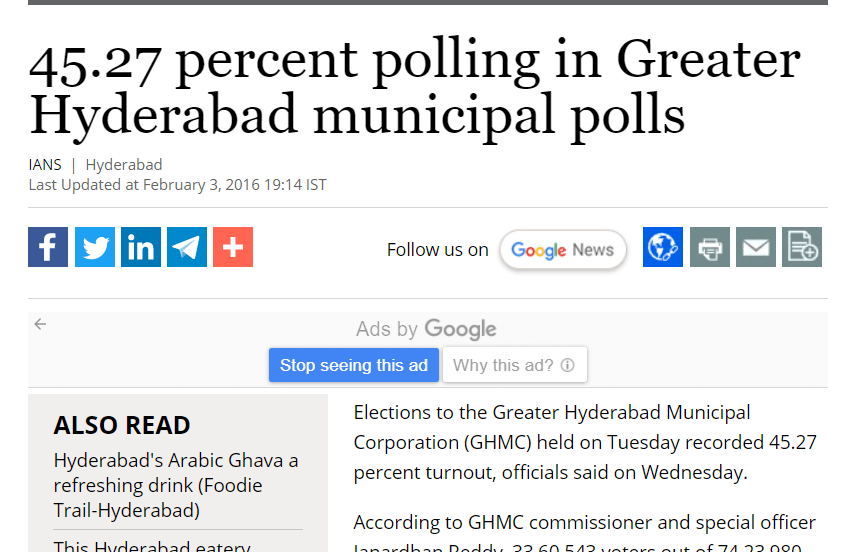
Other metropolitan cities like Bengaluru, Pune, Chennai, Kolkata reflect the trend. A common cause that is cited for the low turnouts is the apathy and cynicism towards the voting process.
Apathy though is not the cause, merely a symptom. The causes for the apathy vary with different socio-economic groups. But one common thread that connects all the strata of society is the ‘social capital’.
Social capital is the network of relationships between people living in a society. Low turnouts signal a non-participation of people in the democracy. It is a barometer of measuring the social capital. When the interdependency between the people and the governance system is fragile, the citizen engagement is at a minimum.

Source: Medium
The engagement of citizens is low when the ‘Political Interest Index’[3] is low. The segments of population who have vested interests in the local governance system are more likely to vote. As they are the beneficiaries of the local laws and schemes. The poor, elderly, married couples mostly fall in this segment.
Assuming all these people vote gives a skewed understanding. Their social status in society plays a role in determining who votes. The highly educated, young and female population who are politically disinterested do not vote. They perceive their social capital to be diminished as local governance does not affect them.
Bangalore Mirror[4] discusses the reasons of apathy. Names of eligible voters go missing from the electoral rolls. This indifference shown by the system begets indifference of the public. It tells them they do not matter. They believe their participation does not change the political landscape.
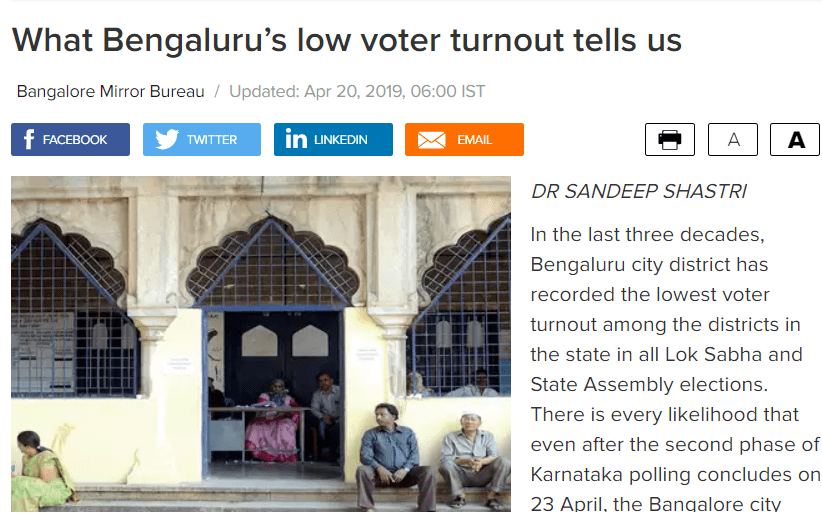
Source: Bangalore Mirror
As a result, proportionally misrepresented bodies get elected due to skewed voting patterns. This deficit of trust needs to be bridged by building social capital to bring these voters to the booths on voting day.
[1] Business Standard – Feb 2016: 45.27 percent polling in Greater Hyderabad Municipal polls
[2] WHY-PEOPLE-DO-NOT-VOTE-IN-MUNICIPAL-CORPORATION-ELECTIONS-A-VOTER-BASED-SURVEY-IN-MUMBAI-MUNICIPAL-CORPORATION.pdf, GIPE
[3] WHY-PEOPLE-DO-NOT-VOTE-IN-MUNICIPAL-CORPORATION-ELECTIONS-A-VOTER-BASED-SURVEY-IN-MUMBAI-MUNICIPAL-CORPORATION.pdf, GIPE
[4] What Bengaluru’s low voter turnout tells us




 The Critilizers
Leave a comment