
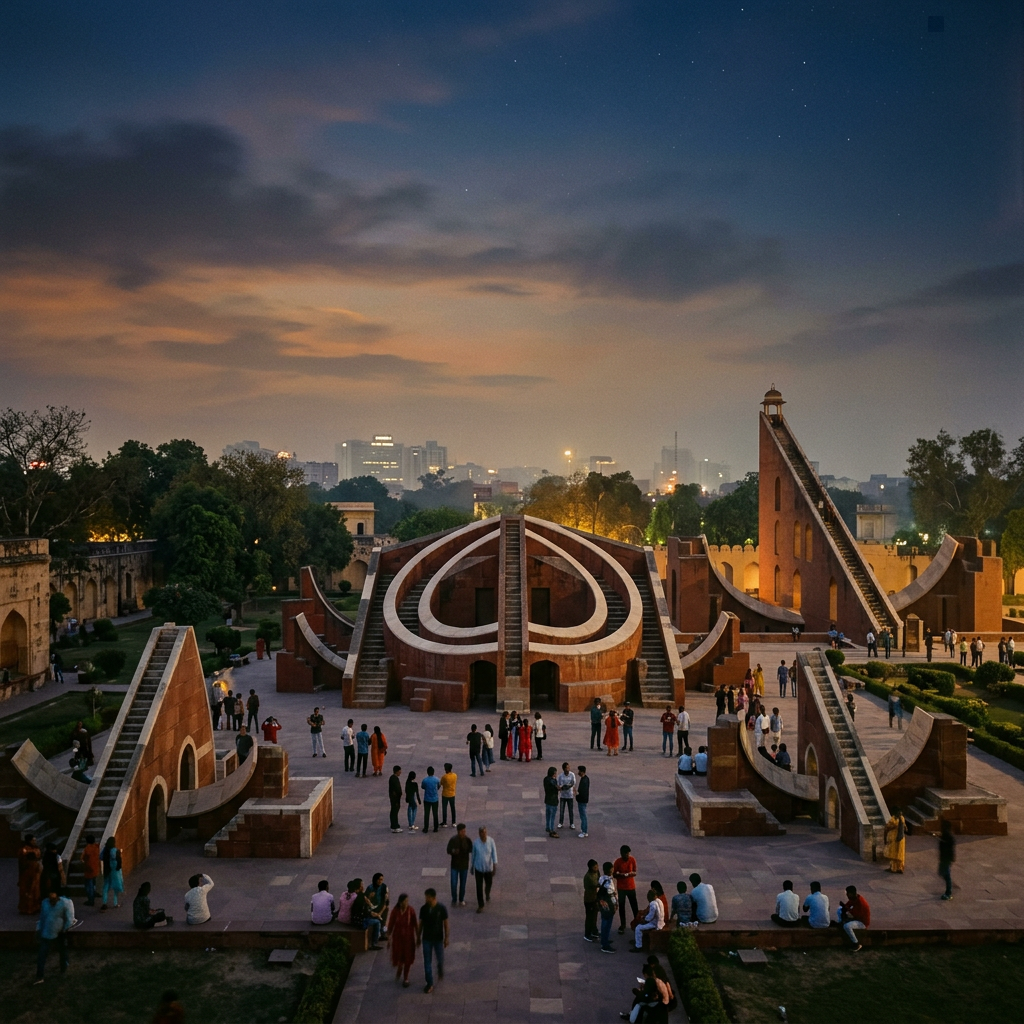
In the season of repeated protests, Jantar Mantar emerged as the focal point of attention. Recently, it witnessed the NEET paper leak protests and rise of the CJP. Their constant threat to protest at Jantar Mantar created a nuisance value.
After a hatchet job by the Indian Express to find glaring malpractice in the SIR (Special Intensive Review) of the electoral rolls , the CJP threatened drop a hat protests everyday at Jantar Mantar. It vitiated the peace and harmony and disturbed the daily life of citizens in the area.
This continued nuisance value due to protest progressing to anarchy led to the denotification of Jantar Mantar as a protest. Suffocated by protests since 1993, playing witness to 35 major protests, this is a fresh lease of life for this historical monument. This opportunity should be seized to right the distortion and celebrate it as a symbol of Indian science and scientific temper.
What Is A Jantar Mantar?
The etymology of the phrase has its roots in Sanskrit. Jantar is derived from the Sanskrit word ‘yantra’ which is synonymous with instrument, apparatus, or machine. Mantar is derived from ‘mantrana’ meaning – to consult, calculate, or deliberate. The words combined together translate to “instrument used for calculation”.
So, what is the Jantar Mantar used to calculate?
A Jantar Mantar is an astronomical observatory. It consists multiple stone made instruments, designed to be used with the naked eye. These instruments were used to compile astronomical tables and predict the times and movements of the Sun, Moon and the planets.
As the years passed by this observatory became a historic monument. Later in 1993, the Jantar Mantar was designated as a site to protest. Since then, the ethereal wonder and mystifying scientific instruments disappeared from the Jantar Mantar narrative. It became associated with political protests.
Legacy As A Protest Site
To shift protests further away from the Parliament, the Congress government disallowed protests at Boat Club lawns opposite the old Parliament. It notified Jantar Mantar as the new site for protests.
Jantar Mantar located 3 km away from the Parliament, ensures a protest there grabs the eyeballs. Situated close to the official ministry offices, media houses, India Gate, and on the way to Raisina Hill, a protest here is a spectacle for the members of Parliament and the diplomats. With media coverage and the potential to internationalize an issue, protesting here worked as a good pressure tactic.
From 1993 to October 2026, the historic monument has been witness to many protests. A diverse range of stakeholders have used it as a stage to make their voices heard. And the issues too were varied. There were protests expressing dissatisfaction against decisions of other countries. Citizens, support groups, unions, NGOs, ideological organisations participated in protests against corruption, women’s safety, examinations, individual rights, and at times development as well.
Listing all the protests can make it a cumbersome read. I will try to highlight a few of the notable protests over the last three decades.
- Indian civil society raised their voice in 2003 against the invasion of Iraq by the US and its allies
- Medha Patkar, as a part of ongoing agitation of the Narmada Bachao Andolan, protested against the Sardar Sarovar Dam in 2006
- In 2010, the lawyers and other support groups from Telangana protested for the creation of a separate state
- The tumultuous period from 2011 to 2013 saw a wide range of protests – the India Against Corruption protests, the Justice for Nirbhaya protests after the horrific gangrape in Delhi, decriminalisation of Section 377
- In 2019, there were protests against the repeal of Article 370 and introduction of the farm laws and amendment to the Citizenship Act
- In July 2026, students and CJP protests against paper leaks after the NEET PG paper leak
- The CJP tried for an encore at the Jantar Mantar on the SIR issue in October issue.

During the intervening months July – October, after tasting success during the NEET protests, the CJP threatened protest if any issue was not handled to their satisfaction. They tried to dictate to the government, to the court, and the executive. Their latest attempts exhorting ‘GenZ’ to protest every other day created a law and order situation.
Detained on October 10, 2026, as they attempted to protest against the Special Intensive Revision of the electoral roll, they signed a bond to not disturb the peace. Violating the signed bond of peace, they called for a protest on October 14, 2026. This continuous blackmail to protest at Jantar Mantar and the subsequent police effort to uphold the peace, impacted the daily lives of the local population. This led to the denotification of Jantar Mantar as a protest site. In lieu, the government proposed three alternate sites – the Ramlila Maidan, Burari ground, and East Delhi’s CBD ground.
There is intense debate on the denotification of Jantar Mantar as a protest site. Most of the debate is framed around the idea of freedom and right to protest. The rhetoric of the opposition is about snatching Jantar Mantar back to uphold the right to protest.
However, I believe the denotification of Jantar Mantar as a protest site returns the historic monument to the people. They can explore, understand, and marvel at Indian engineering and science of the 18th century.
Cultural Significance of Jantar Mantars
While the Jantar Mantar in Delhi is widely known for it remains in the news cycle, there are four more Jantar Mantars in the country. They are located in the cities of Jaipur, New Delhi, Mathura, Varanasi and Ujjain.
Commissioned by Raja Sawai Jai Singh, a pioneer in statecraft with a profound interest in the field of mathematics, architecture, astronomy, astrology, and literature, the Jantar Mantar observatories were built at multiple places across the country. Built between the years 1724 and 1737, these observatories were built to assemble astronomical data to predict the movement of the planets and other celestial bodies in the solar system.

In the Jantar Mantar at Delhi, there are 13 architectural astronomical instruments. Among these 13, there are four distinct instruments – the Samrat yantra, the Jayaprakash, the Rama yantra and the Mishra yantra.
What does each yantra calculate?
The Samrat Yantra, a giant triangular sundial, measures solar time; the hemispherical Jayaprakash Yantra maps celestial positions; and the paired cylindrical Rama Yantra measures the altitude and direction of celestial bodies. The Mishra Yantra combines five instruments to track solar positions and compare noon at different locations. Together, they demonstrate how monumental architecture served precise astronomical observation.
Of the five observatories, the Jantar Mantar in Jaipur is the most famous of these structures. But it had deteriorated by the end of the nineteenth century. The Jantar Mantar in Delhi met the same by the end of uprising in 1857.
While most of the Jantar Mantar observatories stand as a symbol of the past, the Jantar Mantar is Ujjain is still a functioning observatory. Situated on the Tropic of Cancer, the city of Ujjain is acknowledged as the traditional centre of Indian astronomy. At the latitude and longitude of 23°10’58”N & 75°46’38”E, the prime meridian passed through the ancient city.
Over the years, the Jantar Mantar at Ujjain, also came to be known as the Vedh Shala. Scholars and astronomers continue to use the instruments to date to calculate the trajectory of celestial objects and prepare the Hindu panchang (almanac). The panchang is a sophisticated time keeping system occupies an important in the activities conducted in Hindu households. This lunisolar calendar serves as a guide for determining auspicious times for rituals, festivals, and important life events. It influences various aspects of daily life, including agriculture, medical practices, and business decisions.
With the denotification of Jantar Mantar as a protest site, either the Archaeological Survey of India or a private entity with expertise in historical and monument conservation can take up the mission to transform the space into embodying the spirit of scientific temper in India.


Leave a Reply