

In the last three years, the NEET-UG examination paper was leaked twice. In 2024 and in 2026. With their educational future in jeopardy, the students were visibly upset. They sought accountability from the government and demanded the resignation of Union Education Minister, Dharmendra Pradhan.
While the government took corrective measures to immediately conduct the exam again and arrested the perpetrators, it obfuscated and patronized in communication. The students felt their issues were not taken seriously. There was no attempt to reach out to the students to hear their grievances.
After the CJP created ruckus near the Parliament and turned the protest into a violent demonstration, the government realized they needed to rein in the situation. The education minister resigned. The Public Examinations (Prevention of Unfair Means) Act was amended.
But this does not solve the issue of exam leaks. While the protests at Jantar Mantar continued, the paper for the Pharmacist Officer recruitment exam was leaked. An FIR was registered and 35 people – 28 candidates and 7 organizers – were arrested.
Looking at the data from the India Paper Leaks dataset curated by Sujay Nadkarni on Kaggle, 2026 witnessed six paper leaks. The table pasted below lists them down. With four months remaining this calendar year, there is a possibility the list could expand.
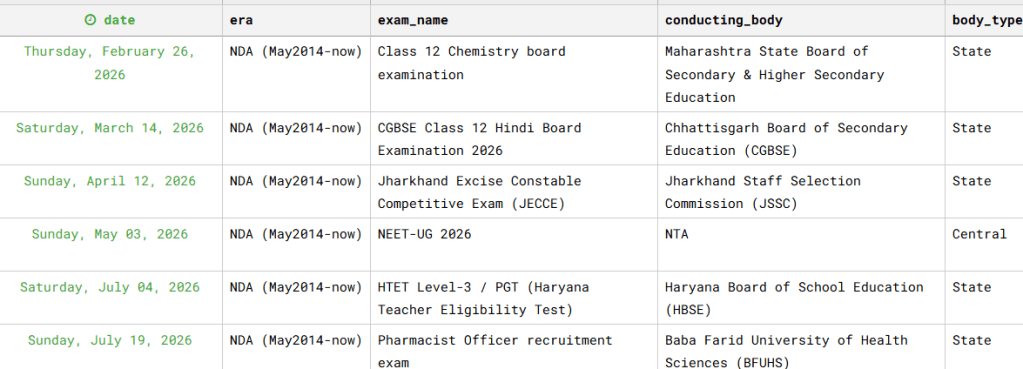
Widening the timeline, since 2004, there are 110 recorded instances of paper leaks in the country. It includes a host of graduation, entrance, recruitment and promotional examinations. Exams conducted by state and central bodies fell prey to the malpractice effecting scores of students. Like a bad penny the event is repeated multiple times every year.
What Incentives Paper Leaks?
To understand why exam leaks occur frequently, we need a look at how we see education. Education is the only means to climb up the financial ladder for a large population in the country. Despite having accumulated wealth, a large segment of the middle class is one disaster away from losing their hard earned money. Hence, sending their children to a college or university is a need they have and are willing to spend money on it.
Of the varied educational streams, the STEM courses of engineering and medicine offer a direct pathway to a stable income and life. This results in a horde of students queueing up for engineering and MBBS seats. As of 2026, the 823+ medical colleges in India offer approximately 130,000 seats. In the NEET exam over 2 million (20 lakh) students compete for these 130,000 MBBS seats.
Shifting focus to engineering, there are nearly 1.5 million (15 lakh) B.Tech seats in India. Of the available 1.5 million seats, the JEE exam offers admission for just 67,253 seats in the premier engineering institutes – IIT and NIT. Over 1.6 million (16 lakh) competed for the available 67, 000 seats.
Securing a good enough rank ensures, the kids get quality education paying a modest, reasonable fee. But this gets highly competitive due to the scarcity of seats at premier educational institutions. To give the kids the best shot at succeeding in the competitive entrance exams, people turn to coaching institutes.
These coaching institutes strip down education from an endeavour to seek knowledge and understanding concepts to a certificate as a commodity to be eligible for higher education. This process encourages rote memory and only teaches tips and tricks to crack the entrance exams. Theoretical understanding and application of concepts is ignored. Coaching institutes charge a hefty amount from pupils for this.
Need for Coaching Institutes: Are Schools Not Doing The Job?
In a risk-averse society, the road to a stable to a life resembles a fad. When the economy was closed in the 1970s and 1980s, government jobs offered a stable career. People rushed to get a cushy government job. Post the economic liberalisation in 1991, there was increased interest in pursuing careers as an engineer or doctor.
The pedagogy of our school curriculums is focused on broad topic coverage for descriptive board exams. The teaching is focused on reading a textbook in classroom and rote memorization. It does not prepare students for entrance exams for higher education that require rapid multidisciplinary problem solving, logical reasoning, exam techniques and tricks. This skill gap birthed the coaching centres.
And the scarcity of seats in higher education enabled them to gain a foothold in the education sector. Parents were willing to pay hefty fees to send their children to these institutes. As a result, the cost of education considerably increased. Today, these coaching centres have evolved into a Rs 58,000 crore business.
It is estimated the valuation is likely to reach Rs 1,00,000 crore by 2030. These institutes offer coaching programs for a host of entrance examinations over multiple disciplines. The benchmark of their success is the ability to ensure the students get good ranks in the competitive exams. It creates cut throat educational and business environment.
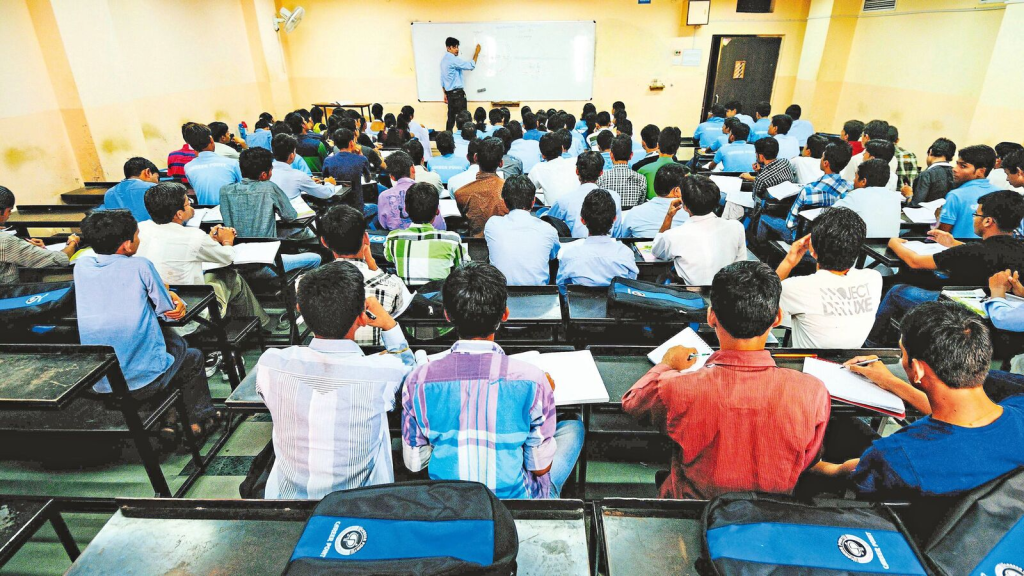
To prepare the students, the coaching centres put them through an intense regimented schedule. Long hours, tips and tricks to solve questions, and continuous testing become the norm. This Darwinian attempt at education separates the wheat from the chaff. Students are segregated based on their alleged potential to succeed at the exams. These students are accorded the best faculty to improve their chances of success.
Source:Mint
Despite paying the fees, the remaining students are ignored. They receive a sub-par education. Neither are they provided with a good academic foundation to ace their boards nor are they given the right tools to ace entrance exams. As such these coaching centres turn into ‘Animal Farms’ where they state all students are equal, but some students are more equal than others.
Poor policy and inadequate incentives turned the education sector into a for-profit business venture. And the coaching centres have the deepest pockets. They successfully poach teachers from private and government schools. While it is a loss of a good teacher for a private school, this practice promotes teacher absenteeism in government schools. It impacts the quality of education in schools.
What Can We Do To Address The Issue?
The common sense answer is to invest in scaling up infrastructure and resources in schools. However, to quantify the desired result and achieving it is a complex process. Education is a subject ignored in India. The seriousness accorded to it is a reflected in policy.
India unveiled its first education policy in 1968. It aimed to aimed to provide free and compulsory education for all children up to the age of 14. The policy failed to provide access, quality, and equity in education. To address this, India introduced its second national education policy in 1986. Both the first and second educational policies failed to achieve their objectives.
While the state and union governments trying to use affirmative action for access and equity in education, the world moved on. The education policy and curriculum did not keep up. It took another 34 years for the government to revisit the education policy. The NEP (New Education Policy) aims to arm students to be employed in the changing jobs landscape. It remains to be seen if it is destined to meet the fate of its predecessors or will it help chart a new path.
Through the NEP, the union government is leading a slow overhaul of the education system. It has launched PARAKH National Assessment Centre to reform the examination process. Established under the aegis of the NCERT, the PARAKH centre aims to establish equivalence between various school boards in the country. This ensures a level playing field for students across the country. It emphasizes on competency-based examinations that prepare students for the industry.
While I applaud the initiative to move away from rote memorization, this is still a one size fits all solution. And it does not impart rapid problem solving skills, pattern recognition and logical reasoning required for exams. I think this gap can filled by prep schools.
As India embraces the New Education Policy, the US-style prep schools are a good fit along with the private and government schools. Unlike coaching centres, where the teacher to student ratio is acute, the prep schools function on a limited intake schooled by qualified professionals. This enables students to build an educational roadmap suitable to their strengths and interests.
Also, prep schools teach foundational concepts first. Once a student understands the conceptual learning, the focus shifts to exam strategy. This model of education prepares students for their school examinations and entrance tests.
However, the success of such a customized education model depends on the availability of teachers and creation of prep schools. This requires training teachers, creating suitable curriculum, and providing modern amenities. It requires capital expenditure, especially from the state governments to implement this at the state level.
But the states themselves would be one of the major roadblocks for the policy idea. The poor fiscal health of states does not leave them with much money for capital expenditure. Based on CAG report on state finances, a majority of the allocated budget in the state budgets is spent of revenue. It leaves behind a paltry amount for states to spend on capital.
Attached below is the breakdown of the spending levels and composition of revenue and capital expenditure on education across the four highest-spending states
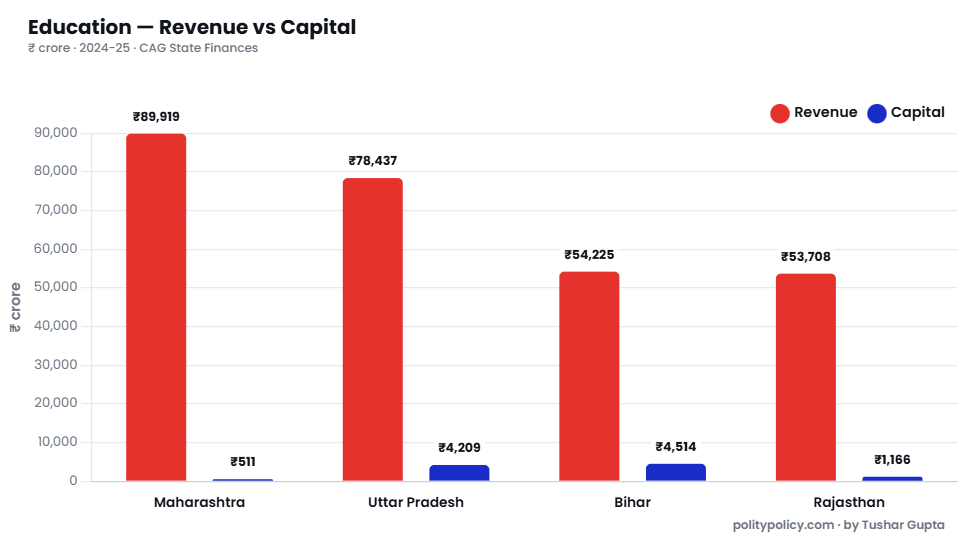
So, for every ₹1 spent on capital expenditure, Maharashtra spends about ₹176 on revenue expenditure, compared with ₹46.1 in Rajasthan, ₹18.6 in Uttar Pradesh, and ₹12 in Bihar.
If expressed as capital expenditure as a percentage of total education expenditure, which may be more intuitive for comparison, the figures are approximately 0.6% Maharashtra, 5.1% UP, 7.7% Bihar, and 2.1% Rajasthan.
For meaningful reform in education, this fiscal situation of state finances needs to be addressed. A state with healthy fiscal situation can afford to intervene and address the market inefficiency. At present, schools are engaging with coaching centres to train students for entrance exams. The visits to schools with camera or amending laws is not going to stop paper leaks. It requires a correction in the market, ensuring education is customized to student and helps prepare students for the current economy.

 The Critilizers
Leave a comment