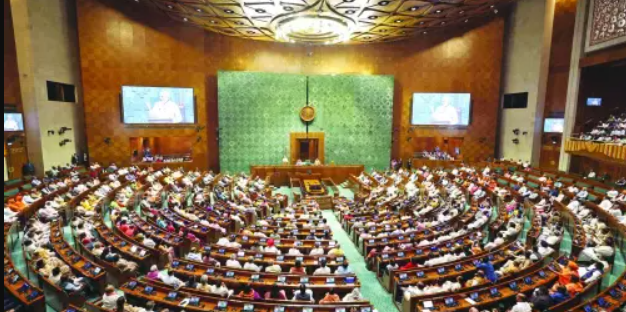
The Indian electorate will vote into power a new legislature over the course of the next few weeks. This elected legislature is expected to debate, deliberate and legislate to come up with implementable laws and policy frameworks to tackle issues of importance in a time bound manner.
Timely legislative decision making requires efficient functioning of the Parliament and the State Assemblies. The efficient functioning of these institutions demands accountability of the elected representatives. It requires the elected Members of Parliament and Legislative Assembly to be civil, punctual, and conduct legislative business in an orderly fashion.
However, in the prevalent political atmosphere, ruckus and pandemonium have become the business to be transacted in the union and state legislatures. It has resulted in reduced productivity, and delayed legislative action – leading to denial of remedy and agency for grievance and redressal and creating a window for unwarranted judicial overreach.
To seek a more responsible and accountable legislature and arrest the fast decline in working days, there is a need to be more vocal about it. It requires a continued and concerted effort to keep the discussion alive. The issue should not just be limited to a talking before the commencement of a Parliamentary Session.
Data compiled by PRS Legislative Research shows that the 17th Lok Sabha – between June 2019 and February 2024, held a total of 274 sittings. Only four previous Lok Sabhas had fewer sittings, for they were dissolved before they could complete their five-year term. For a Lok Sabha that completed its term, the 17th Lok Sabha recorded lowest number of sittings.
Of the 15 sessions held across its scheduled five-year term, 11 sessions of the Lok Sabha were adjourned sine die before the stipulated duration of the session. The early adjournment of the Parliamentary sessions resulted in the loss of 40 scheduled sittings.
With an estimated cost of Rs 2.5 lakh per minute being spent to run the Parliament, as presented by the former Parliamentary Affairs Minister Pawan Kumar Bansal in 2012, loss of 40 working days is a colossal loss to the state exchequer.
This misuse of such a large amount of tax payer money should be a cause for concern. However, there is a more alarming trend that needs to be arrested. With successive Lok Sabha elections, the average annual sitting days of the house was taken a huge dip.
The 1st Lok Sabha elected in 1952 during its tenure, ensured the Lok Sabha on average sat for 135 sitting days every year. The successive Lok Sabha tenures saw a steady decline in the average sittings of the Parliament. By the 17th Lok Sabha, the average annual sitting days has come down to 55 days.

Source: PRS Legislative Research
This hides a larger malaise affecting our parliamentary procedures. Reduced sitting days of the Parliament resulted in shorter discussions on bills tabled for legislative business. The legislative business marred by disruptions resulted in passage of bills with little to no discussion.
Of the 179 bills, excluding the Finance and Appropriation bills, passed in the recently concluded Lok Sabha, 35% of the bills were passed within less than an hour of discussion. In the Rajya Sabha, a similar percentage of bills were passed within the same duration of discussion.
These bills passed with miniscule amount of deliberation in the Parliament were often passed amidst the protests and walkouts of the Opposition. As a result, the bills were passed by a voice vote. Only 9 percent of the bills introduced were passed with clause by clause voting and voting on amendments.

Source: PRS Legislative Research
From the data presented, it is evident that the productivity of the Parliament has diminished over the years. The State Assemblies in the country, however have performed far worse. State legislatures on average have met for less than 30 sitting days between 2019 and 2023.
The average number of sitting days in Madhya Pradesh dropped down from 27 in 2014-2018 to 16 in 2019-2023. The legislatures of Chhattisgarh and Telangana on average conducted house business for 23 and 15 days respectively. There are state legislatures having worked for lesser number of days. As per data published on the Punjab Legislative Assembly website, in the calendar year 2023, the State Assembly worked only for 11 days.
This recalcitrant attitude of the lawmakers resulted in laws being enacted without enough deliberation. This behaviour of the lawmakers provided the space for the judges to wade into the issue.
Former Chief Justice of India (CJI) NV Ramana, during his tenure commented laws passed without constructive debates are leading to legislation with a lot of ambiguities. Lack of deliberation on legislation in Parliament and State Legislatures do not provide the rationale about the intent and purpose of the law. Without debates on legislation, the burden of interpretation is left to the judiciary.
The judiciary relies on the Parliamentary debates and scrutiny of the law in Parliamentary committees to interpret the law. With deliberation over law and scrutiny of intended acts becoming a rarity, there is no clarity in the intended purpose of the law. With only 12 percent of bills sent to Parliamentary committees in the current term of the government, there isn’t sufficient scrutiny on the societal impact, tools of implementation, and the manpower required to implement the proposed laws.
The need for reforms in the working of Parliament was felt as early as the turn on the millennium in 2000. The JMNR Venkatachaliah Commission, otherwise known as the National Commission to Review the Working of the Constitution set by the NDA government in 2002 suggested recommendations to improve the efficiency of the Parliament.
The Commission suggested fixing a minimum number of sitting days for Lok Sabha and Rajya Sabha. It proposed a minimum of 120 and 100 sitting days for the lower and upper houses of the Parliament.
For the state legislatures, the Commission proposed the following – houses of legislatures with less than 70 members should meet for at least 50 days a year and other houses for at least 90 days.
Enshrined within the law, as a codified statute, it would be binding upon the governments of the day to meet the minimum requirements. This would require the lawmakers to debate, deliberate and reach a consensus which as of date is partisan and elusive.
Discover more from The Critilizers
Subscribe to get the latest posts sent to your email.

 The Critilizers
Eye opening and devastating state of sessions being held vis a vis the legislations passed with least deliberations- !!! And they get paid huge salaries and perks for exactly this!!!!! Well written informative piece that needs wider awareness amongst masses!!!! https://ruparaoruminates.wordpress.com/
LikeLiked by 1 person
Thanks a lot atha! 😀
This piece was originally written for publication for the newspapers. After waiting for 3 weeks, without any response from them, I published it here.
LikeLiked by 1 person
We the “ people” are to be blamed for electing such politicians to lead our nation.
LikeLiked by 1 person
I would agree with you to a certain extent. People not turning up to vote enables power hungry and greedy representatives get elected.
However, the electorate is not solely responsible for it. As I write this there are some interesting thoughts popping up in my head. The emergence of an Opposition in the 70s and 80s, and the rampant misuse of Article 356 has created a staggered election cycle.
Stuck in a perennial election cycle, governance is hindered with the Election Commission’s Model Code of Conduct applied every few months. The political shenanigans to topple governments to wrest power or form new post poll alliances only add to the issue at hand.
Will the proposed ‘One Nation, One Election’ help in addressing the issue? Theoretically, one can argue or present a case, but how it will unfold remains to be seen.
LikeLike
very good information for the public Hardik
LikeLiked by 1 person
An excellent sharing.
LikeLike