

India is in the midst of a transformation. As India rises up the economic ladder, the aspirations and expectations of the people grow manifold. Building on the 1991 economic reforms, the recent changes in the Indian economy have ushered in a steady increase in income levels.
Improved household incomes have altered consumption patterns. The working paper by the Economic Advisory Council to the PM, “Changes in Durable Goods Ownership in India,” maps this change. A few salient insights show that there is near-universal access to mobiles, a growing ownership of motor vehicles, refrigerators, and television sets in the bottom 40% households. These indicators highlight the end of ‘roti, kapda, makan’ mindset of the populace.
With greater access to mobile devices and low-cost data, people now have global exposure. They witness the standards of public amenities, infrastructure, and governance across the globe. Compared to what is offered at home, they are dissatisfied and questioning the establishment. The legislative, the executive, and the judiciary find this to be quite a challenge.
The young Indian citizen is highly aspirational and wants the elected governments to address the issues. The young population is bustling with energy and is ready to keep its date with destiny. But is the establishment ready to meet their aspirations?

Source: Eye on Asia
The Early Days
Embroiled in the politics of poverty, social engineering, and irresponsible fiscal promises, the political parties pandering to their vote banks are oblivious to it. News channels and influencers are children playing with the latest piece of information circulating in the vast expanse of social media. Amidst this din on television and the disconnect of elected representatives, a new voice is emerging.
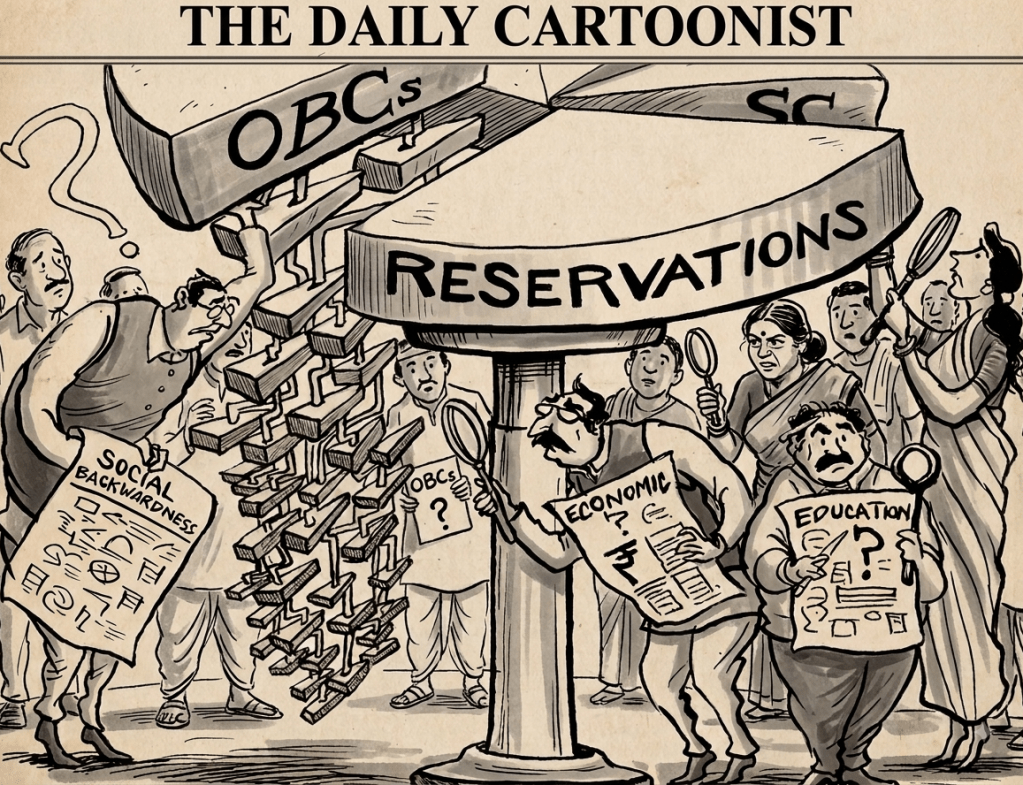
This tech-savvy generation is seeking accountability. Using the democratized social platforms, they are asking the uncomfortable questions. Organic engagement is shaping commentary on a wide range of issues. It has provoked conversations on waste management in cities, pothole-ridden roads, corruption in the bureaucracy, the state of the judiciary, widespread food adulteration, rising costs of education and housing, pitfalls of reservation policies, utilization of MPLAD funds, and more. The list is endless.
A common thread tying these diverse narratives together is the inefficiency and inability of the state apparatus. In the heydays of Orkut, Reddit, and instant messengers, people met on online forums to discuss issues and events. These forums organized themselves as communities to create awareness, register online protests, and engage in political discussions. It was a galvanization of like-minded people to address contemporary civic issues.
Social Media As A Catalyst for Change
Though the days of Orkut fostered digital communities, their impact was limited. The rise of social media platforms provided them with a much larger and broader platform. And so is the impact. Over the last few years, there have been multiple instances of demands and initiatives that have forced governments, the judiciary, bureaucrats, and corporations to back down or make amends.
This basic demand of accountability is making them uncomfortable. Instead of performing their jobs of alleviating the lives of the citizenry, they are trying to hold on to their feudalistic seats of power. In recent years, a slew of incidents reflect the same.
Governments Tackling Corruption
Let us begin with the basics. Bureaucratic corruption is a malaise that pervades all states. No government institution is without exposure. Every family has a story of paying a bribe to get an official document. Be it a death certificate, passport application, property registration, or some other document. Frustrated with prolonged visits to obtain permissions and documentation from multiple departments, the people succumb to the system.
Making an effort to instill a semblance of confidence, the Anti-Corruption Bureau and Vigilance Units have carried out drives to root out corruption. They share the information about the arrests on their social media handles. That is the extent of it. So, netizens began to question the outcomes of the cases filed against the corrupt bureaucrats and government employees.
At most, these government employees arrested for corruption get a suspension. Looking at the available data for 2025 ACB records, Maharashtra registered 682 cases, followed by Telangana with 199 cases, Gujarat filed 187 cases, and Andhra Pradesh registered 115 cases. However, getting cases registered does not guarantee prosecution.
To protect government officers against malicious action, the Civil Services Rules were established to safeguard their interests. The rules mandate sanction of prosecution by the state government or the central government. Investigative agencies are required to obtain a sanction within 90 days.
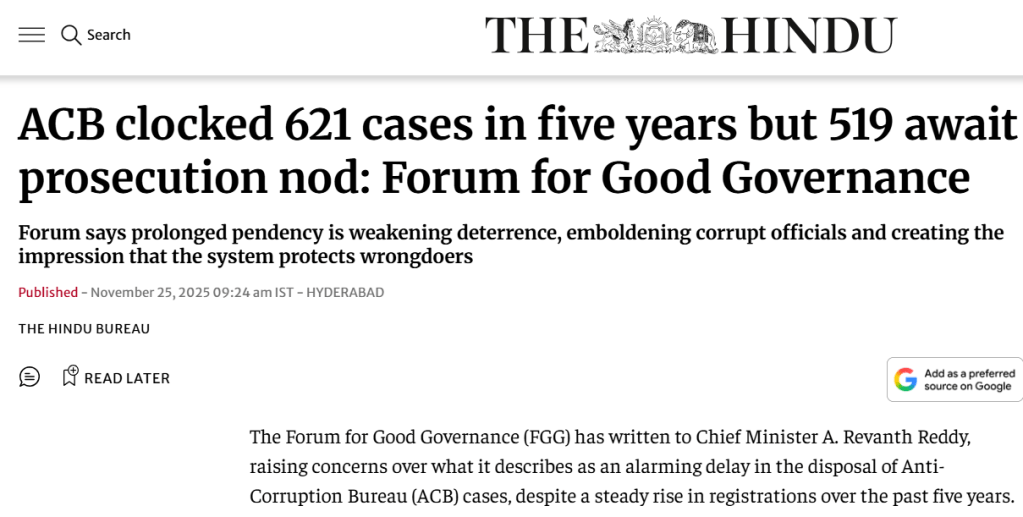
However, state governments do not decide on the requests and leave them pending. In Rajasthan, 403 corruption cases await prosecution sanction since 2022. The VACB in Kerala is awaiting sanction in over 500 cases. The Telangana ACB (Anti-Corruption Bureau) has been unable to prosecute 519 corruption cases over the last five years. As state governments do not provide sanctions, the investigation is halted. And chargesheets cannot be filed. With no charges framed against the accused bureaucrats within the 3-month window, they are reinstated into the bureaucracy.
The Andhra Pradesh ACB DG, Atul Singh provided the 2025 data, highlighting shortage of staff at the agency. Due to these constraints, officials demanding bribes of less than ₹10,000 were ignored, and the matter was forwarded to concerned officials. With a significantly understaffed bureaucracy, the same story could be playing out in other state ACB and Vigilance Units. This skews the system of checks and balances, allowing corruption to flourish.
Citizens Challenge The Government to Fix Things
A fallout of it is a lack of accountability. Politicians and bureaucrats use this unchecked system to delay work or perform shoddy jobs. Fed up with the apathy of government officials, a hashtag #YeThikKarkeDikhao went viral. It was a challenge to all tiers of government to fix the issue. Each post with the hashtag would highlight a civic issue in different parts of the country. The hashtag has evolved into a Twitter handle of its own.
The X handle rose to prominence, publishing data on the utilization of MPLAD funds. These are Local Area Development funds provided to each parliamentarian for development initiatives. Sharing data from the official MPLAD portal maintained by the government helped gauge the performance of the parliamentarians.
There were two salient findings. One, the allocated funds were underutilized by the members of parliament (MPs) in their constituencies. Two, despite payments being made for completed projects, there was no evidence of proof of work attached to the website. It led to a flurry of posts questioning the lack of evidence submitted. As information from multiple constituencies was put online, the government restricted access to the MPLADs portal. After severe backlash, access was restored.
Fallout of Apathy of Governance
This apathetic attitude trickled down into government officials at the lower tiers as well. The administrative system gets sloppy, and without meaningful checks to curb such behaviour, this attitude gets reinforced and rewarded. In a state with a low number of state and local government officials, citizens are at their mercy. This toothless government machinery allows the private sector to fleece the common man.
For instance, the denial of health insurance claims is a grave concern. Of late, health insurance grievances are on the rise in India. They account for 67.5% of total insurance claims. The contentious issues with health insurance claims include improper rejection of claims, unfair deductions, and cashless authorization delays.
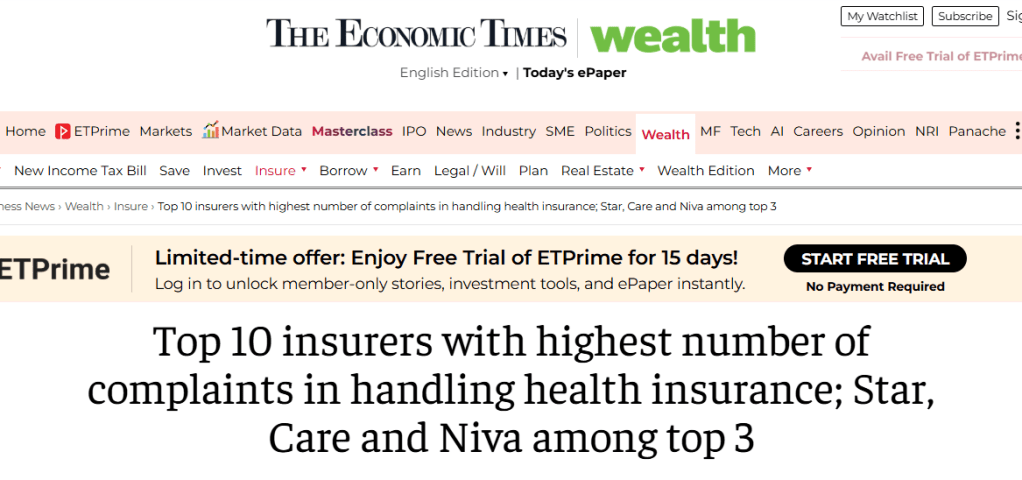
Data from the Council of Insurance Ombudsman shows Star Health & Allied Insurance received the largest number of complaints (13,308 in FY 23-24 and 12,186 in FY 24-25), followed by CARE Health Insurance (3,718 in FY 23-24 and 4,423 in FY 24-25) and Niva Bupa (2,511 in FY 23-24 and 3,983 in FY 24-25). These insurance providers top the list for the last two fiscal years. The other prominent insurance providers are not far behind.
This regulatory failure emboldened insurance companies to deny claims for frivolous reasons. It leaves people at risk of financial bankruptcy despite being covered by insurance. With a similar lackadaisical attitude, the scourge of incompetence is now impacting our health in food and medicine as well.
As India becomes more health-conscious and fitness-conscious,, people started to check what they consume. A citizen-led initiative in this direction was led by Revant Himatsingka. Popularly known by his social media handle Food Pharmer, he started the ‘Label Padhega India initiative. Described as the second biggest consumer awareness program after ‘Jaago Grahak Jaago,’ the initiative had significant gains.
First, it highlighted how international FMCG brands got away with selling food and beverages containing harmful ingredients compared to other prominent markets. It forced brands like Bournvita to reduce sugar content and Lays to switch from palm oil to healthier options. Second, the effective social media campaign forced regulators to improve food labeling guidelines. Also, it put the spotlight on FSSAI (Food Safety and Standards Authority of India) – the food security watchdog of India.
Indian netizens started questioning the efficacy of the body. Its glaring failure to let companies get away with selling substandard products put FSSAI under the spotlight. Growing concerns about food safety saw related issues discussed in Twitter spaces, reels, posts, and blogs. This led to a growth in citizen journalism, displaying the widespread malaise of food adulteration. As the posts started to multiply on social media platforms, people were shocked at the extent of adulteration.
Food items used daily in the home and commercial kitchens – dairy products (milk, paneer), spices, ghee, oil, and other flavor-inducing condiments were found to be adulterated. Toxic substances were mixed with food substances. The quantity of such products weighed as much as 1000s of kilograms. As the issue gained traction on social media, FSSAI started shooting the messenger. It started filing FIRs against influencers and social media handles, raising the issue of food adulteration. The recent controversy regarding the falsification is not helping matters either.
To list things that fall under the prism of the citizens raising issues affecting their daily lives, this can be a never-ending post. We have seen Dr Sivaranjani Santosh getting the ORS labels removed from sugar-heavy drinks. And expats are trying to clean Bengaluru roads. The list can go on. How do we improve this situation?
The solution sounds pretty simple. To build capacity and capability at the local and state government. However, it requires hiring the right talent pool having the ambition to create a change. Asking questions of the government and holding them accountable is a good thing. But, it is just half a solution. This rising new population that is looking for change also requires an introspection. Talking about doing the right thing from the comforts our home is easy. We are talking the talk. To achieve the desired standards of living, we need to walk the walk as well.




 The Critilizers
Leave a comment