
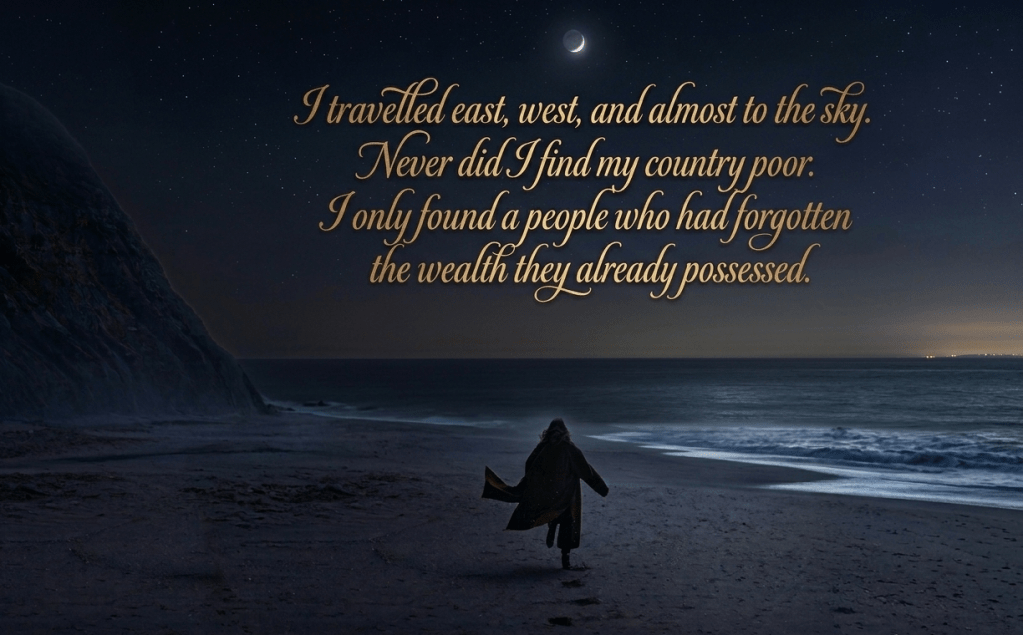
People often ask whether our country is poor.
I no longer know how to answer that question.
I have travelled through villages, towns, cities and mountains. Within a few hours of a journey, the language changes, the food changes, the festivals change, the architecture changes, the songs change, and even the way people smile changes. I have seen cultures layered upon cultures, each carrying centuries of memory, each possessing a richness that cannot be measured on any balance sheet.
Yet, almost everywhere I went, I found wealth and poverty standing side by side.
Not the poverty that governments measure, but another kind.
I met a barber who knew more about people than many psychologists. A potter who could create beauty from ordinary clay. A doctor who healed strangers as though they were family. A scientist who chased questions no one else dared ask. A teacher who shaped generations without ever appearing in history books. A lawyer who carried justice in his words. A businessman who could build enterprises from nothing. A dancer who preserved stories with every movement. A singer whose voice carried the emotions of an entire community. A politician who understood every village road, every family dispute, every forgotten dream. A writer who could give language to silence.
Each of them possessed something extraordinary.
Each of them was rich.
Yet almost every one of them believed they were poor.
Not because they lacked talent.
Not because they lacked purpose.
But because they compared themselves to someone who possessed something different.
The artist envied the businessman.
The businessman admired the professor.
The professor envied the politician.
The politician admired the industrialist.
The industrialist envied the peace of the farmer.
The farmer admired the doctor.
Everywhere I travelled, the grass seemed greener on the other side.
That made me wonder.
Is the individual convincing himself that he is poor?
Or is society constantly whispering that he is not enough?
If an entire society teaches its people to overlook their own gifts, perhaps that society is poorer than any economic survey can ever reveal.
I tried learning from these people.
I wanted to become a little richer—not in money, but in skill. Rich in understanding. Rich in conversation. Rich in craft.
Ironically, the same people who inspired me often thought I was foolish for valuing such things. Respect rarely came when I admired their skills. It arrived only after they noticed a few possessions I happened to own.
The treatment changed.
Not because I had become wiser.
Not because I had become kinder.
Not because I had become more capable.
Simply because they believed I owned more.
That was the day I realized something uncomfortable.
Society can make a man with a handful of possessions feel like a king.
A poor king.
A king constantly afraid of losing what he owns.
To me, a real king is something else entirely.
A king is someone who knows how to build, how to endure, how to rebuild after disaster, and how to remain steady when everything around him collapses. Such a person carries a kingdom within himself. Even without a palace, even without land, even without wealth, he remains a king wherever he goes.
What truly confused me was something else.
The things I had always considered signs of poverty were often treated as normal.
Compromising one’s skill for convenience.
Selling one’s self-respect for approval.
Treating relationships as transactions.
Demanding wealth instead of character in marriage.
Ignoring craftsmanship while worshipping luxury.
Remaining silent when conscience demands courage.
These forms of poverty rarely appear in economic reports.
Yet they impoverish civilizations.
Meanwhile, we undervalue the things that make us truly wealthy.
Ideals,Friendships,Trust,Culture,Craft,Knowledge,Art,Character, art of building an empire ,business etc
Communities spend generations creating these treasures, only for individuals to exchange them for possessions that depreciate with time.
Sometimes, even people become transactions.
Sons become investments.
Daughters become negotiations.
Relationships become contracts.
And someone else becomes richer from the bargain.
Perhaps that is the strangest poverty of all.
People often ask me what wealth is.
I still do not know.
If wealth means living in luxury, then I have met many poor millionaires.
If wealth means owning property, then history has buried countless wealthy men whose names nobody remembers.
But if wealth means possessing something that continues to enrich the world long after you are gone, then I have met kings disguised as school teachers, philosophers hiding behind tea stalls, poets sitting in barber shops, and artists living in homes no economist would ever call prosperous.
Once, a great poet reminded us that a nation is made rich by its people, not merely by its land.
The more I travel, the more I believe that to be true.
Perhaps our greatest poverty is not the absence of wealth.
Perhaps it is our inability to recognize the wealth we already possess.
Perhaps the possessions I hold today are still not enough for society to take these thoughts seriously.
Till then, I shall continue travelling in search of a few more possessions—just enough to earn the right to be heard—while quietly learning the art of building empires from people who believe they are incapable and poor, even as they remain far richer than they know.
 The Critilizers
Leave a comment