
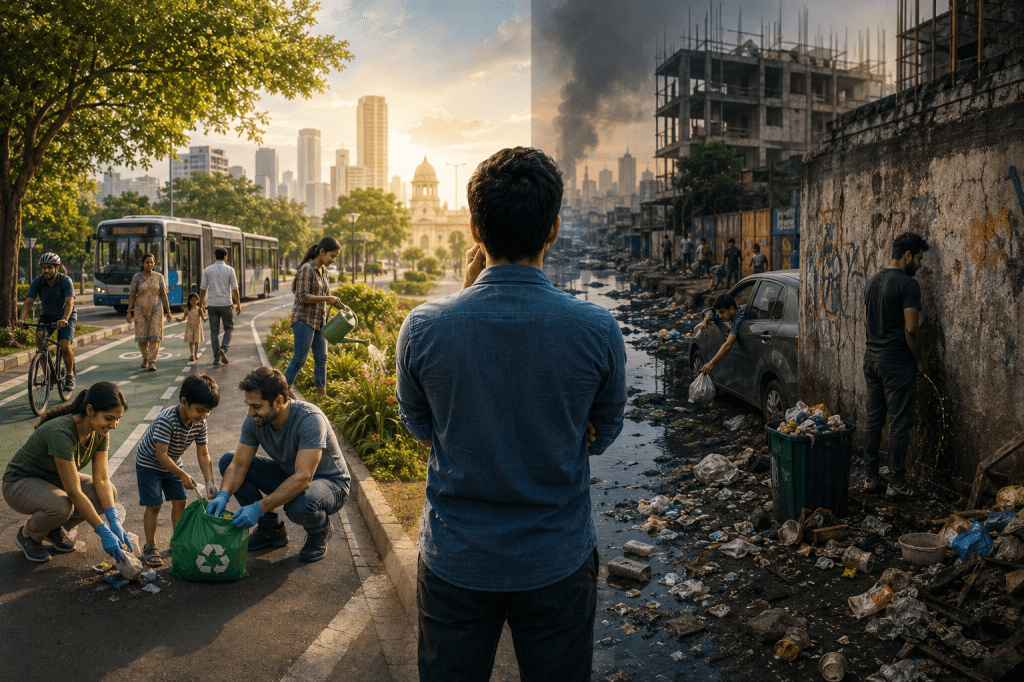
Of the people, by the people, for the people. These words delivered by Abraham Lincoln in his famous Gettysburg Address, over the years, acquired resonance as a descriptor of democracy. Often, democracy is equated with casting a vote during the electoral process. The idea of a democracy is much larger than that.
From the ancient Indian republics and the governing Sabhas and Samitis to the modern nation-state, the participation of the citizens is paramount in a democracy. Proper citizen participation requires a balance of duties and rights. In recent years, a greater emphasis on rights has eroded the importance of duties.
In my previous post, the focus was on citizens in India using social media to hold governments accountable and making it tough for them to evade scrutiny and responsibility. Flipping the narrative, this time it is citizens who are under the scanner. Are they doing their bit before pointing fingers at the elected representatives?
As citizens, we want efficient delivery of public goods and services. Asking governments how our tax income is utilized is important. Misuse of the public exchequer requires scrutiny. The question to be answered, however, is how we treat and maintain these public goods and services.
The Slippery Slope of Jugaad
Considering the median population, there is a pretense of lip service offered from the comfort of convenience. Often, convenience trumps order as we have hardwired the concept of ‘jugaad’. In a recent op-ed, Soumitra Bhattacharya, serving on the board of Bosch Limited, pointed out that jugaad is not a strength as we foray into global manufacturing. I believe the same logic applies to civic sense and responsibility as well.
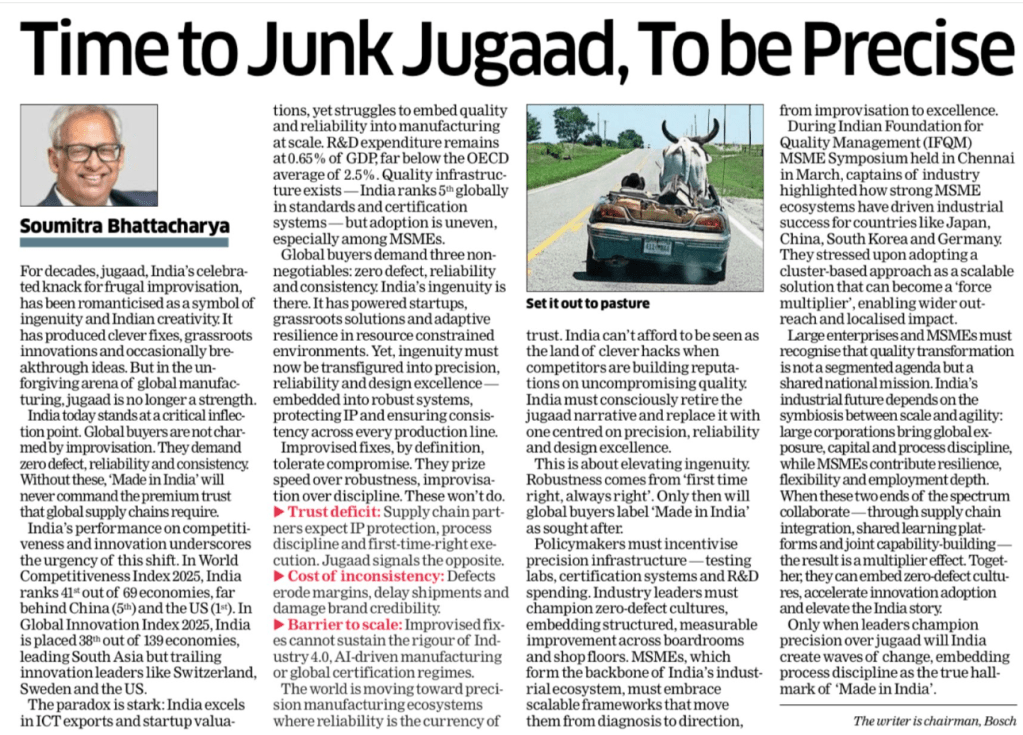
Having chosen the convenience of jugaad in everyday interaction, we burdened ourselves with challenging living circumstances. The clever hacks we devise to reduce time and effort later become fatal. A common rule we flout daily is driving on the wrong side of the road. For some, it is about saving time and distance. A few people justify it by citing fuel savings. For others, flouting the rules is an accomplishment.
While this makes sense in their heads, this puts pedestrians at risk. It makes them prone to accidents, injury, and death. If fortunate, they suffer scrapes, broken bones, or non-fatal injuries. If not, they end up in hit-and-run situations, vehicular collisions, or death. This desire for a quick fix to get to your destination can ruin lives.
Flouting road rules is quite tame compared to violating building codes. For the proper disposal and treatment of sewage generated by inhabitants, the drain outlets need to be connected to the municipal main drain. To cut costs, builders do not always connect it to the municipal main drain. The sewage outlets are connected to the inlet drains of existing or abandoned water bodies.
Dumping untreated sewage into nearby water bodies pollutes the water, the water table, and degrades the natural ecosystem of the water body. Cities in India have lost many lakes and ponds to such unscrupulous practices. These water bodies turn into waste dump sites, creating landfills. Chemical leachates and harmful organisms such as E.coli, mold enter into the water table. As we use the bores to draw the contaminated water from the water table, we fall prey to a host of medical ailments.
In both instances, the shortcut taken by one person can cause significant harm to families or even societies at large. Jugaad, at best, is a short fix. At its worst, it creates a conscienceless society devoid of civic sense.
Flouting The Rule Book With Pride
Taking a step further, some people graduate from jugaad to kleptomania, theft, and vandalism. The Indian Railways has been a victim of this. Passengers traveling by train always had an urge to pilfer coach fittings. This theft of railway property has been an ongoing issue since the 1980s, if not earlier.
In the 1980s and 1990s, passengers used to unscrew the fans operating on AC current to use at home. To disincentivise theft, Indian Railways switched to installing 110V DC fans. As these fans could not be used for domestic purposes, people stopped stealing them. They did not even spare mugs in the washrooms. It is why the mugs are tethered to chains in the washrooms.
Despite concerted efforts, passengers continue to steal washroom property – from mugs and faucets to dustbins and mirrors – with impunity. Just one small, single line railway division from Keralam, Palakkad, reportedly suffered losses worth ₹8.7 lakh from Dec 2024 to Nov 2025.
With the addition of air-conditioned coaches and trains, the railways provided bedsheets, pillows, pillow covers, and blankets to make passengers feel warm and comfortable. An RTI application filed by The Indian Express exposed the scale of theft.
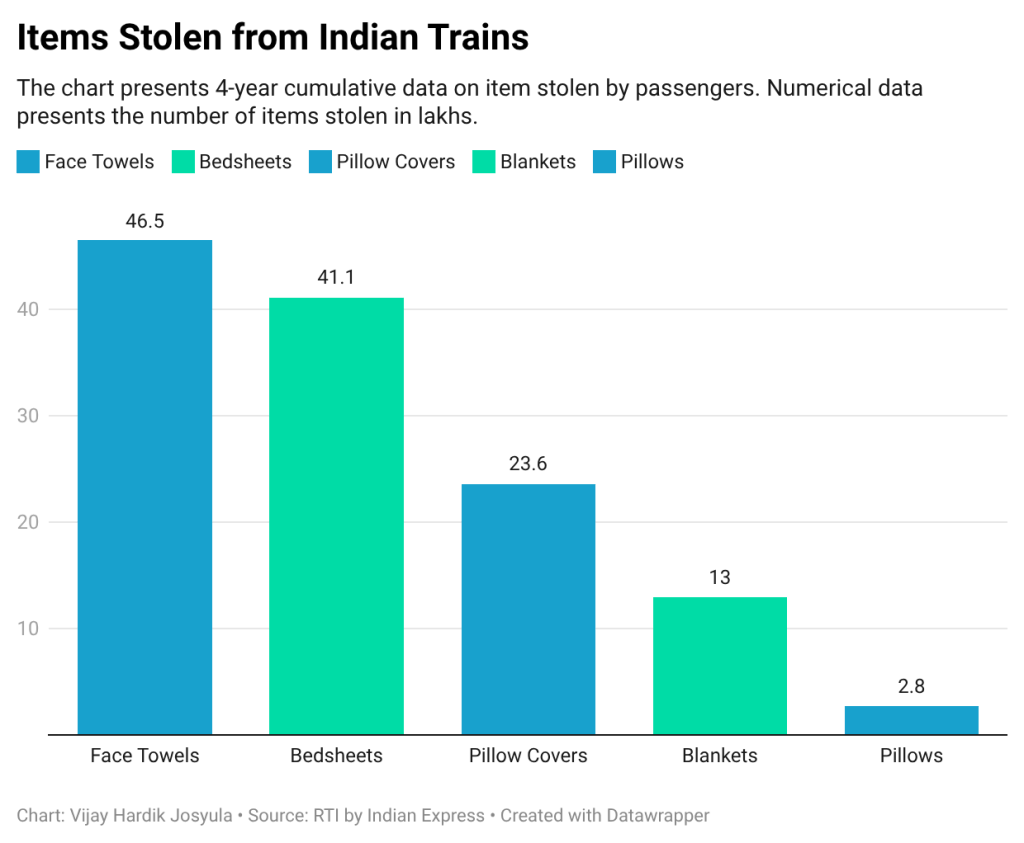
The numbers are shocking. 4.6 million face towels, 4.1 million bedsheets, 2.3 million pillow covers, 1 million blankets, and 0.2 million pillows. Imagine the money spent to replace them! Instead of spending the money on capital, it is spent on revenue expenditure. This theft by passengers impacts the workers contracted to maintain the washroom property on trains. They are paid a modest wage of ₹14,000 – ₹21,000 per month. For each missing item, a fixed amount is deducted from the monthly salary. Due to irresponsible behaviour by travelers, these workers lose ₹2000 – ₹5000 from their monthly pay.
However, the most embarrassing incident happened on the Tejas Express. Hailed as the ‘aeroplane of tracks’, the Indian Railways made an attempt to enhance the travel experience. It installed seat-back LCD screens, headphones, provided on-board WiFi, and even upgraded urinals to bio vacuum toilets.
By the time the train reached its destination on its inaugural journey, passengers stole at least a dozen headphones and vandalized the LCD screens. The train was covered in litter, and the toilets were soiled. Within its first four journeys, up to 337 premium headphones went missing. So, the costly headphones were replaced with less expensive earphones costing ₹30 per piece.
Such an attitude is on display in all public spaces. We steal toiletries from hotels. We deface art structures and monuments. We leave stains of chewed tobacco on walls and footpaths. We urinate by the roadside. It builds a negative perception of people being unable to properly utilize the service and infrastructure provided to them.
This reckless disregard for public property justifies the government’s reliance on the L1 (Lowest Cost) tender process. The L1 process enables government bodies and ministries to minimize capital risk. Also, it creates a window where scrupulous people in the system can inflate costs and deliver shoddy work.
It sets back the reform process. Demands are met with greater skepticism, and the executive gets reasons to delay it. Citizens are pushing for governments to adopt a quality and cost-based selection in the award of tenders for infrastructure, maintenance, and service. But, when the very same citizens destroy, vandalise, and deform public property or flout the rules they fight for, governments do not take them seriously.
If people want to see the change they want, they need to be accountable as well. They should participate in the government and behave like stakeholders in governance. They should become a functioning part of the republic. Come out of the social media bubble and try to understand the issue, meet with the stakeholders, find feasible solutions together, and witness the change.

 The Critilizers
Leave a comment