
India is poised at an interesting juncture in her history. Even as the India story adds a new feather in its cap everyday, it still embodies the dichotomy of the old. India is inching closer to become a $4 trillion economy and soon will be the world’s third largest economy in a few years. This feat will be achieved by sheer dominance of population with an average per capita $3000

Location: Gokhale Institute of Politics and Economics
It is against this backdrop, the theme for the inaugural edition of the Pune Public Policy Festival – trade offs becomes topical. The event was graced by Union Minister Hardeep Singh Puri, Dr Shamika Ravi, Member of the Economic Advisory Council to the Prime Minister (EAC -PM) and other eminent thinkers and public intellectuals.
Centred around the trade offs for the paradigms of growth-equality, tech-privacy and development-environment, the discussion and debate to the following findings – evidence based policy making, localised policy decisions and establishing localised, indigenous public policy frameworks to come up with policy interventions and solutions.
A rudimentary way of understanding trade offs is often found in criticism of big ticket government projects on social media. Big ticket infrastructure projects – the Bullet Train project, the order of 450 odd airplanes from Airbus and Boeing, developing tourist spots and monuments like the Statue of Unity are often juxtaposed with the idea of welfarism using rhetoric instead of logic and evidence.
Evidence Based Decision Making
Evidence based policy decisions enable to help maintain an equilibrium of expenditure and welfarism without harming the process of wealth creation and generation. This is a parameter that is unique to each tier of government – determined by geographical territory, the form of government, and precision of data. In the case of India, the question that begs asking is how much welfarism can we afford with an average per capita of $3000?
However, this a question only for policy making at the top tier of government. The discourse on governance and policy is majorly centred around policy decisions of the Union Government. Despite many important issues – health, education, law and order, agriculture being part of State and Concurrent Lists, the role of the States in policy decision making is not much of a talking point.
The decentralization of the discourse with a focus on policies enacted by State and Local governments is a nascent phenomenon. This for obvious reasons has coincided with the democratization of media platforms. It has led to better access of information and data to enable a better understanding of the reality we live in.
To quote, Dr Shamika Ravi, sole focus on policy decision making at the national level is a “lazy approach” to understanding public policy. She used the phrase to emphasise her point of evidence based decision making promoting localized policy decision making at the lower rungs of government.
Dr Ravi made her point citing India’s progress on bringing down its Maternal Mortality Rate (MMR). The last government press release on MMR shows a significant decline in MMR from 130 in 2014-16 to 97 in 2018-20, much closer to the global SDG goal of 70/lakh live births. Her presentation showed that the issue of MMR is a cause of concern in 7 states in the country. Taking the example of Madhya Pradesh – the data highlighted the problem was limited to a few districts across the length and breadth of the state.
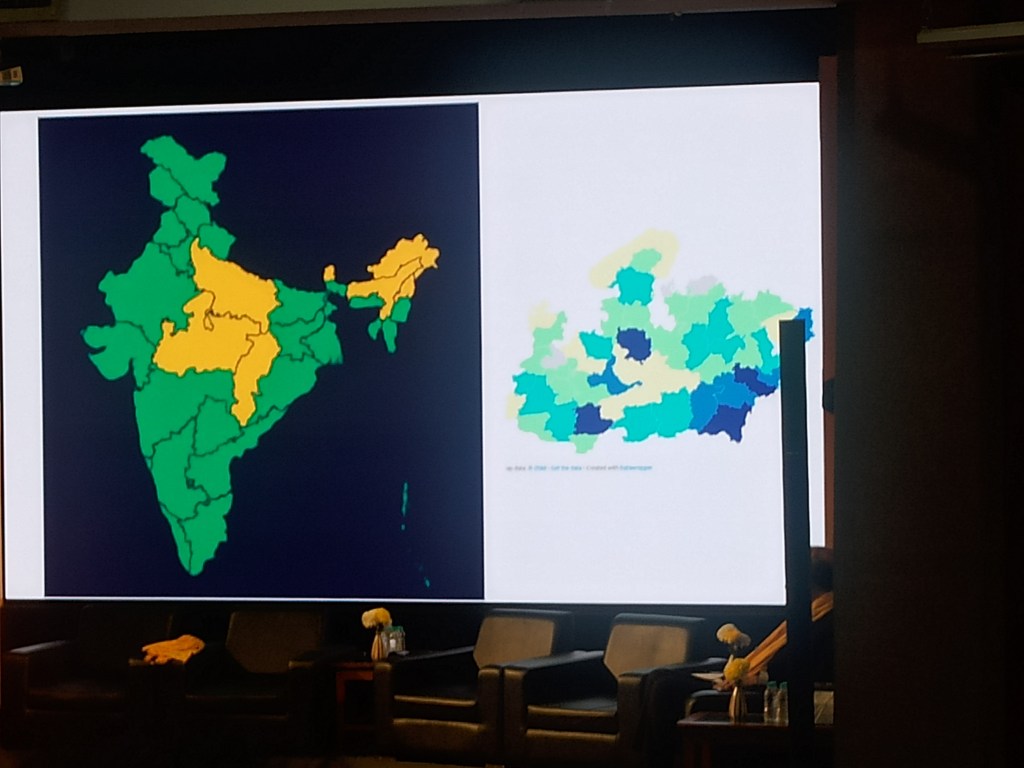
Source: Presentation of Dr Shamika Ravi
In such cases, it is prudent to have localized policy decisions with an understanding of causal effects based on the local socio-economic situation. Waiting for a policy solution to arrive from Delhi might take months or years leaving the problem in the lurch.
This positive change was precipitated by the rising economic growth in the country. The alleviation in economic prosperity across the population demographic brought down the MMR rate across the states in India. Yet, the growth and development immediately fall prey to criticism mostly in the guise of highlighting trade offs.
The Growth Debate
The discourse on growth always comes into combat with environmentalism. Loss of rural land, destruction of habitat, reduction in green space are bandied about and often picked up by the media. It is not to suggest that these situations do not arise, but of most developmental projects face criticism by a few piggybacking on social justice and environment.
Sterlite protests against the Vedanta copper plant in Tamil Nadu or the Aarey protests against the Metro Car shed are recent incidents. These development projects are means of providing access and improving ease of life. Gaining access helps bring the means of production closer, provide livelihood and catalyse economic growth in the area.
This needs right, targeted, and specific spending of total capital outlay to spur long term growth. Rapid urbanization has seen increased total outlay expenditures. With estimates of 65% of India’s population living in cities by the end of the decade, the outlay expenditures are only going to rise.
However, to get the desired results, the capital outlay needs to spent the right way. The responsible expenditure of the outlay needs to be backed with proper planning, strategy and astute policy decisions. It results in creating required infrastructure, housing, transport aided by policies created by the government to facilitate a conducive environment for business. This trickle down effect leads to job creation, delivery of government services and improved ease of living.
The idea to set up ward offices under the GHMC Citizens Charter in an attempt to decentralize administration for swift grievance redressal . Or coming up with the National Urban Policy to deal efficiently with rapid decadal urbanization require strategic expenditure of capital outlay are instances of policy reforms to unleash the potential for rapid growth.
Wasteful expenditure of outlay can have disastrous consequences. The state of Punjab had the highest per capita income in India in the 1980s and ranked fourth on the list in 2001. By 2021, Punjab had the 16th highest per capita income.
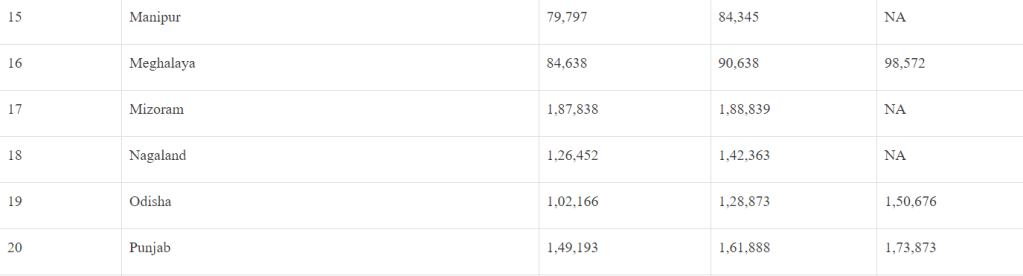
Source: PIB Press Release
Continuing to believe in the fiction of India’s food basket, the governments in Punjab failed to provide good governance. The policies adopted by the government of Punjab have actively contributed to the deindustrialization of Punjab. They are heavily reliant on funds from the Central Government for policy action. It leaves them vulnerable without any capacity for local policy initiatives.
Localized Policy Decisions
The idea of localized policy making has two aspects – decentralized policy decisions and adopting policy decisions compatible with local norms and customs. A common peeve with policy makers in India they rush to adopt the latest fad.
The rush to bring in ESG norms into financing and trade treaties determined by Western cultural and industrial standard backed by low populations and high per capita incomes is one such fad. The premature celebration of providing 26 weeks of maternity leave without pondering about first and second order effects. It indeed is a laudable move to empower women, yet the achieved outcome is the opposite of the intended result. A policy decision to make life easier working female professionals has led to lesser women on the workforce.

Source: Business Insider
Educated policy makers should put aside the Westphalian epistemology to public policy to come up with effective policy solutions aligned with the socio-economic rubric of the localized geography. One of the challenges to a rapidly urbanising India is the challenge of urban governance. For inspiration, we look up to the usual suspects of London, Paris, New York to find solutions.
Instead, policy makers in the can take a leaf from the Panchayati Raj system to decentralize governance and deepen public participation. Villages in India hold the Gram Sabhas at least twice a year to deliberate on outlay, planning and projects. These regular meetings reduce misallocation and corruption. An initiative on the similar lines at the ward level would be to create Ward Sabhas to encourage indigenous forms of localised governance.
Such localised and indigenous solutions might have a better chance at tackling issues at lowest rungs of governance. This is not advocacy against global best practices, it is a caution against adapting a copy-paste policy and an attempt to derive policy solutions that are feasible, viable and easy to implement and gain acceptance.
The post-COVID era has provided many instances where taking policy decisions in national interest and against the grain of global perception has helped India catapult into a more robust economy. This has been achieved through engaging the local domestic capacity. The participation and inclusion of this domestic capacity can help tackle these bottlenecks to policy making in India
Discover more from The Critilizers
Subscribe to get the latest posts sent to your email.

 The Critilizers
well researched, detailed write- good one… https://ruparaoruminates.wordpress.com/
LikeLiked by 1 person
Thank you! 🙂
LikeLike
Really interesting post, very informative.
LikeLiked by 1 person
Thanks Pooja! Glad you found the post to be an interesting read. All credit goes to the speakers at the Pune Public Policy Festival for providing great food for thought.
LikeLike