
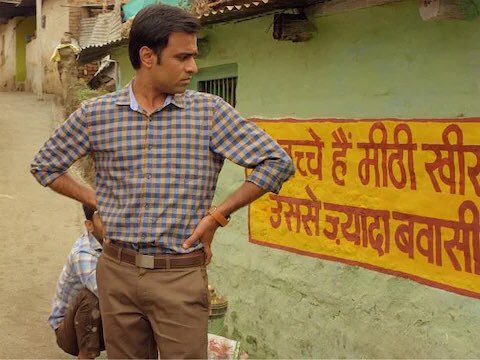
The popular web series Panchayat streaming on Amazon is a refreshing simple drama harking bark to the heydays of Doordarshan. This rural drama series, with its three seasons, has caught the nation’s attention for its portrayal of characters, fresh screenplay, and its relatability. But, the focus of this post is not about its visual brilliance. It centers on the central conflict of the show over the last two seasons. This is the construction of a road in the village.

This issue in the fictional village of Phulera is a reality in many Indian villages. Despite having the second largest road network in the world at 66.7 km, the road density in India, adjusted to population, is still low. There has been an increase of 59% over the last 9 years. The lack of road connectivity can be attributed to many factors. One among them is the poor functioning and efficacy of the local rural environment.
As exhibited in the the show, the Panchayat acts as a conduit for the implementation of welfare initiatives. It also facilitates government services provided by the Union and respective State government. This decentralization of administration has not empowered the local government to become the authority for planning, decision-making, and implementation, despite the stated intent of the 73rd Constitutional Amendment.
The governing body is shown to have minimal autonomy in managing financial resources and framing policy for local issues. The catalyst for development initiatives depicted in the show are either motivated by the necessities of the protagonist or are a result of orders or directives issued by the government to implement welfare schemes and awareness.
To cite a few examples, the process to get solar powered lights installed in the village or the quest to rid the village of the superstition of a haunted tree is necessitated to meet the needs of the protagonist. On the other hand, digging a local water body, constructing a toilet in the ODF declared village, allocating houses under the rural housing program, or attempts to create awareness on family planning are all activities to fulfill official mandate. These activities are not a result of autonomous decision making.
A Standing Committee on Rural Development report – ‘Improvement In The Functioning of Panchayats‘ addresses the lack of autonomy. It also addresses the capacity of the Panchayats. The 73rd Constitutional Amendment is well known as the Panchayati Raj Act. It left the prerogative of devolution of powers and authority to the Panchayat to the State governments.
It observes that the State governments have not devolved power and authority to the rural governments. Subjects like fuel and fodder, non-conventional energy sources, rural electrification, non formal education, and small scale industries are related directly to the rural economy. These subjects have not been devolved to the Panchayats.
Lack of devolution of meaningful authority to the Panchayats by state governments made these local rural governments lame duck bodies.
As noted in the report, Panchayats failed to hold mandatory meetings and had poor attendance. To fix the lacuna, the committee recommended state governments to set up a quorum in Gram Sabha meetings. This quorum should include the participation of Panchayat members, including women.
With a large focus on Digital Public Infrastructure (DPI), a system of monitoring activities of all three tiers of PRIs was brought in. The government launched the eGramSwaraj portal as a work based accounting application for the PRIs.
The Panchayat Information Dashboard provides us with a few data points. But, the data point for Gram Sabha meetings as recorded on the portal is a big fat nothing. There is no data available for the number of meetings of the elected body.
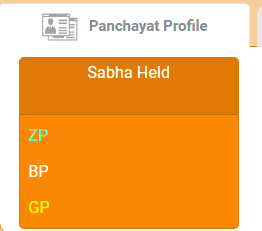
This makes it hard to provide institutional support and makes it hard implement meaningful policy intervention to improve efficiency. Not only does it lead to bad planning and decision making, it hampers economic growth of the area and leaves the local government without much revenue.
Coming back to Panchayat web series, lack of revenue is a contributing factor to the inability of Phulera Panchayat to construct a road in the village. The elected members had to plead for the necessary funds. They had to plead with the elected representative of the state legislature to grant funding for the developmental project.
To get a delivery of public good mandated by law, elected representatives of the local government resorted to shenanigans. They did this to appease the local MLA. The elected representatives of the local government, as a favor to the MLA, had to join a protest. They saw interference in the local elected body and faced an attack by the said member of the state legislature. All for the want of a concrete road.
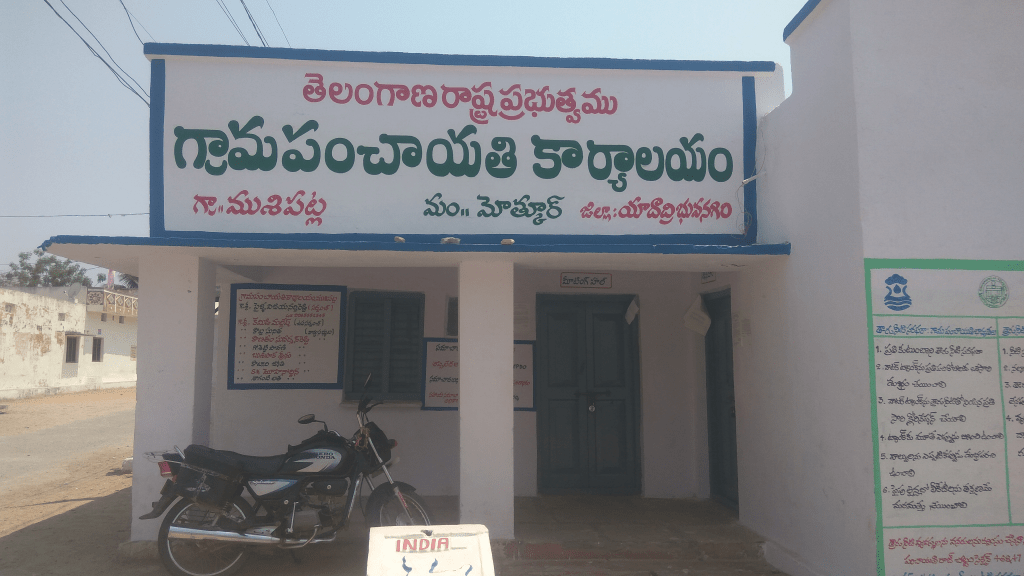
The question arises why did the Panchayat desperate to convince the MLA to get funds to construct a road! It is because the local governments do not have enough revenue sources to meet the fiscal needs. Despite the constitutional devolution of power through the 73rd constitutional amendment, the local governments do not enjoy financial independence.
Source: Wikipedia
The Panchayati Raj Act set forth specific on fiscal devolution including generation of own revenues. The Panchayati Raj Acts enacted by the state governments modeled on the 73rd Amendment. These legislative acts enabled the local governments certain sources of tax and non-tax revenue. Panchayats can earn revenue through property tax, cess on land revenue, and surcharge on additional stamp duty. They can also earn revenue through tax on profession, advertisement, and user charges on water and sanitation. Yet, these sources of revenue account for a measly 1% of revenue earned by the Panchayats.
The remaining 99% of revenue is given to the Panchayats by the Central and State governments through the budget. It is also given in the form of grants, aid, or loans. Despite having the authority to give fiscal autonomy, the state governments neglected to make local governments robust and effective.
State governments are constitutionally mandated to set up the State Finance Commission (SFC). The role of Finance Commission to study the financial status and health of the state economy. The body submits a report recommending how the state can optimally spend its revenue and meet its obligations. The recommendation and suggestions on financial devolution are made the State Finance Commission on which the state governments act.
Per Article 243I, the State government is mandated to constitute the State Finance Commission. The findings of the RBI report on municipal finances show the SFCs across states failed live up to their mandate.
For a body, that is supposed to ideate and give direction the financial budget of states, the SFCs take on average 32 months to turn in their report. They also decide on the devolution of finances to both urban and rural local governments. Then, the state governments take their own time tabling the report in the State Legislature. On average, governments take 11 months to table the report.
State governments take an approximation of 43 months (more than 3.5 years) to just table a report on the finances. By the time, the recommendations and suggestion are distilled into ideas, the next election cycle is upon the government. This keeps the local governments dependent on the grants and aid in perpetuity.
It shows that despite the attempt to decentralize governance through the Panchayati Raj Act in 1992, the devolution of power to the local governments in incomplete. Democracy has yet to percolate properly through the final tier of governance.
- References:
- Prime Video: Panchayat
- Road Infrastructure In India: A Snapshot Of Its Current Status and Future
- Standing Committee Report Summary – Improvement In Functioning of Panchayats (Link: https://prsindia.org/files/policy/policy_committee_reports/SC%20Report%20Summary-Improvement%20in%20the%20functioning%20of%20Panchayats_for%20upload.pdf)
- Having Panchayats As Self-Governing Institutions
- Article 243I in Constitution of India (Link: Indian Kanoon. org)
- RBI Report on Municipal Finances (Link: https://rbidocs.rbi.org.in/rdocs/Publications/PDFs/RMF101120223A34C4F7023A4A9E99CB7F7FEF6881D0.PDF)
Discover more from The Critilizers
Subscribe to get the latest posts sent to your email.

 The Critilizers
Loved your commentary Hardik
LikeLiked by 2 people
Thanks a lot for the continuous support and appreciation! 🙂
LikeLiked by 1 person
What a in-depth article. Loved it.
LikeLiked by 1 person
Thanks, Lokesh! 🙂
Glad you loved reading it.
LikeLiked by 1 person